Table of Contents
Paid search captures demand at the query. AI shapes the decision before the visitor reaches your site. Here’s how to convert that traffic.
Paid search has long been the workhorse of performance marketing because you can connect a click to a conversion. But AI-driven search is creating a different kind of referral traffic — one that arrives after an AI system has already helped shape the user’s decision.
Our data shows LLM referral traffic converts at 20%, making it the highest-converting tactic in our dataset and 61% higher than paid search. The challenge is figuring out how to convert that traffic when the journey that led to the click looks nothing like a traditional search.
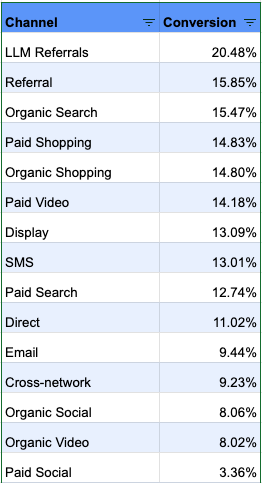
AI search is changing the journey before the click
The growth of LLMs broadly and Google AI Mode is already changing consumer behavior.
Google has reported that the average search query in AI Mode is three times longer than a traditional search query. One in six AI Mode searches is also non-textual, using voice or image-based inputs.
That additional detail and context change the game for brands.
How do you treat a user who comes from an LLM-based search after entering only an image? Will your content even be surfaced in that scenario?
As a result, a new kind of traffic is emerging: LLM referral traffic.
But how does this traffic behave? Is converting a user who clicked a citation in an AI response different from converting someone who clicked a traditional Google Ads search result?
Yes. The journey that leads to the click is fundamentally different, which means the traditional marketing funnel needs to change.
Uncover the keywords, ads, landing pages, and strategies driving your competitors’ paid search success—and find your next opportunity to outperform them.
Why LLM traffic behaves differently from PPC
In PPC, you target intent based on an isolated search query. A search for “best CRM for small business” triggers a specific ad group. The user is presented with several options and is expected to click through to evaluate them.
LLM users operate on context. They might prompt an AI with: “I run a 50-person consulting firm using Google Workspace. What CRM integrates best with it, costs less than $50 a user, and has strong email automation?”
By the time the LLM user clicks a link, the AI has already synthesized the options. The user isn’t looking for a generic landing page comparing 10 CRMs. They want validation of the AI’s specific recommendation. The LLM has done the top-of-funnel heavy lifting.
PPC relies on the click. If a user doesn’t visit your landing page, you can’t convert them.
LLMs, by design, provide the answer directly within the chat interface. This exacerbates the zero-click search phenomenon. When an LLM provides a clickable citation, it is usually because the user requires deeper evidence, a primary source, or is ready to take a transactional step that the AI cannot complete.
That means an LLM referral can represent a much higher-intent action than a top-of-funnel PPC click, although the volume is significantly lower.
Dig deeper: The new search journey changes how SEO and PPC should work
LLM referrals require a different landing page experience
There’s also a difference in how users perceive the two experiences. When a user clicks a PPC ad, they know it’s a paid placement, which creates a built-in level of skepticism.
When an AI model cites your website as a source, the user may perceive it as an objective recommendation.
The AI has evaluated information across the web and selected your content as a source for its answer. That can give LLM traffic a higher baseline of trust, provided your content aligns with what the AI told the user.
If you treat an LLM-driven visitor like a PPC visitor, you risk losing them.
The PPC landing page
- Focus: Immediate action, such as a form fill, purchase or call.
- Design: Stripped down, minimal navigation and an aggressive call to action.
- Content: Benefit-driven copy, bullet points and messaging highly tailored to the specific search keyword.
The ideal LLM landing page
- Focus: Depth, verification and the transition from an AI summary to human expertise.
- Design: Navigable, rich in resources, with clear pathways to deeper information.
- Content: Comprehensive and authoritative, showing why the AI cited you.
When an LLM user lands on your site, they may be fact-checking the AI or looking for the next step. If they’re greeted by a high-pressure, gated form without the nuanced information the AI promised, they may bounce immediately.
Adapting to this shift requires a move from traditional SEO and PPC toward GEO and conversion strategies built specifically for LLM-driven traffic.
What it takes to convert LLM referral traffic
1. Optimize for information gain to secure the citation
You can’t convert LLM traffic if you don’t get the citation in the first place. AI models prioritize content that offers information gain — unique data, proprietary research, primary sources, and expert opinions that can’t be found elsewhere.
Action items
- Audit your content. Are you just regurgitating what’s already on Page 1 of Google? If so, an LLM has no reason to cite you.
- Inject original data, quotes from subject matter experts (SMEs), and unique frameworks into your core pages.
2. Review citations for results and wrap your brand around those sites
If you can’t influence the actual results of the LLM prompt, you can review which websites are cited and where traffic is directed.
At these sites, you can buy display ads through a contextual strategy or pre-roll on YouTube. YouTube is one of the most commonly cited websites. YouTube shows up in 16% of results, according to a report by Bluefish.
Action items
- Review all citations and determine which common sites or blog posts show up in the results.
- Leverage other media buying channels to influence those results with a contextual ad campaign or other digital media buy.
Dig deeper: Why AI visibility starts before search and ends with citations
3. Capture the long-tail conversational lead
LLM users are incredibly specific. They have unique edge cases.
Action items
- Build dynamic conversion paths. Instead of a static lead form asking for name, email, and company, consider interactive elements.
- Use self-serve qualification tools, calculators, or even your own on-site AI chatbot that can pick up the conversation where the external LLM left off.
4. Rethink attribution and measurement
This is the hardest pill to swallow: tracking LLM traffic is a mess. Much of ChatGPT traffic shows up in analytics as “Direct” or “Referral” without granular query data.
Action items
- Move away from relying solely on last-click attribution.
- Implement “How did you hear about us?” fields on your highest-value forms, specifically including options like “ChatGPT,” “AI Search,” or “Perplexity.”
- Monitor overall brand lift and direct traffic correlations alongside major AI feature rollouts.
Dig deeper: A 5-layer framework for measuring AI search performance
See where competitors are investing, which keywords drive their results, and how to capture more of the market.
LLM traffic requires a different conversion strategy
PPC is a game of capturing existing, standardized demand through targeted spending and aggressive conversion funnels. Converting LLM traffic is a game of earning authority, providing profound context, and facilitating a seamless transition from artificial synthesis to human expertise.
Traffic volumes from LLMs may not rival traditional Google Search or PPC campaigns today, but the intent and trust level of an AI-referred user can be unusually high.
By shifting your focus from aggressive, keyword-matched landing pages to authoritative, context-rich experiences, you can turn this emerging channel into your most powerful engine for high-quality conversions.
Topics on this page
If you liked the article, do not forget to share it with your friends. Follow us on Google News too, click on the star and choose us from your favorites.
If you want to read more like this article, you can visit our Technology category.