Table of Contents
Every craft that works in color figured this out long ago. A painter doesn’t rinse one brush between every color; there’s a brush for each one on the palette. Weavers load a separate shuttle for every thread. Pastry chefs fill a piping bag for every shade of frosting. Nobody scrubs one tool clean between colors, because the right one is already waiting. 3D printing took a while to catch up. Most multicolor printers still run every color through one nozzle, and newer four-in-one heads squeeze four colors through a single tip, so every material has to behave the same way. Co Print’s Quadro follows the craftsman’s rule instead: one tool per color. Four independent toolheads, each with its own filament, nozzle and temperature, share a single rail and take turns printing. It’s the oldest trick in the studio, finally built into a 3D printer.
If you’ve printed in multicolor on a single-nozzle machine, you already know about the poop. Every color change forces the printer to flush out the old filament, leaving a pile of rainbow waste that can outweigh the model itself. Toolchangers like the Snapmaker U1 avoid that flushing by picking up and parking whole heads, taking about five seconds per swap. The Quadro skips the pickup entirely, sliding the next head in as the last one leaves, in about one second. Add up to four materials in one print, a 300mm (11.8-inch) cube build volume and early pricing of $649, and this bed-slinger is aiming pretty high.
Designer: Co Print
Click Here to Buy Now: $649 $899 ($250 off). Hurry, only a few left! Raised over $xy.
Four Toolheads, One Rail, and a One-Second Handoff
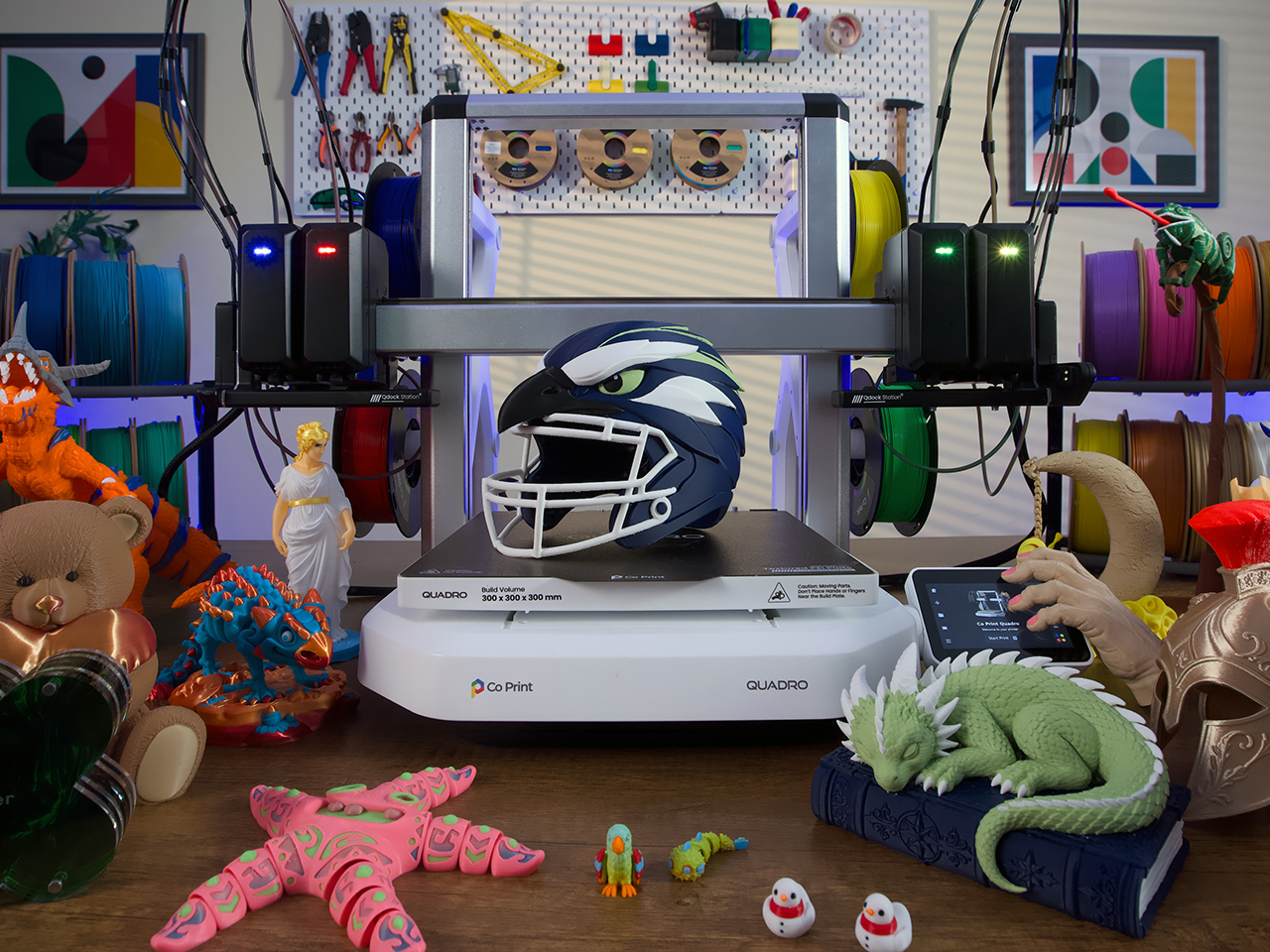
A $649 multi-material 3D printer with 1-second color changes, up to 90% less filament waste and a 300mm build cube, now live on Kickstarter.

Co Print calls the system IQEX, short for Independent Quad Extruder, and it extends the familiar dual-head IDEX layout to four. Each head gets its own stepper motor and belt, with four belts stacked one above another along the gantry. All four ride a shared 12mm linear rail, which means they physically can’t pass each other. Instead, idle heads tuck into docking stations at either end, clearing the bed for whichever head is working. That’s how every head reaches the full 300 × 300mm print area.
During a color change, the active head drives toward its dock while the incoming head moves into position. Co Print’s real-time footage shows a Tool 1 to Tool 2 handoff taking 1.00 seconds, with switches to Tool 3 and Tool 4 taking 1.40 and 1.57 seconds. That compares with roughly 60 seconds for a filament change on a single-nozzle printer, and Co Print says Quadro cuts filament waste by up to 90%. Nothing gets unclipped, grabbed, or reloaded during the handoff, avoiding the grippers and couplings used by toolchangers.
QDock Parking and the Waste Comparison

The parking spots are called QDock Stations, and each one holds up to three heads. As a head docks, its filament retracts slightly and its nozzle tip gets sealed to limit oozing and keep stray blobs off the print. Parked heads also cool to around 140°C to further reduce leakage. About 30 seconds before a head is needed, the printer starts heating it back to its target temperature. The aim is to have it ready to extrude when it leaves the dock.
Since each filament stays in its own nozzle, there’s no need to flush one color out before loading another. The Quadro does print a small prime tower, though, to establish nozzle pressure when a parked head starts extruding again. Zero Waste Mode moves that step into the model’s infill, eliminating the tower on compatible prints. In Co Print’s own four-color chameleon test, the Quadro finished in 9 hours 34 minutes with 34.16g of waste. The single-nozzle printer in the comparison needed just over a day and produced 180.7g of waste, while the toolchanger took 10 hours 5 minutes and produced 44.65g. That’s more than 14 hours faster than the single-nozzle machine, with about 80% less waste. In a larger scale test, the same four-color model left 1,079g of waste on a single-nozzle printer and just 135g on the Quadro.
A Bed-Slinger With a Mostly Metal Frame

Co Print chose a bed-slinger layout, where the build plate moves along the Y-axis, for its relative simplicity and ease of maintenance compared with CoreXY. The frame uses thick-section aluminum rather than thin bent sheet metal, and the load-bearing joints are metal-to-metal. Co Print says roughly 70% of the structure is metal. Even the bed carriage is a single piece of aluminum, designed to stay flat and parallel during high-speed printing.
Two synchronized motors drive the Y-axis through separate belt systems, spreading force evenly across the bed to reduce twisting under hard acceleration. Motion runs on 12mm industrial linear rails, and automatic tensioners are intended to keep the X and Y belts balanced over time, so you should spend less time reaching for a wrench. The Z towers are braced by the filament station structures to help reduce the layer irregularities known as Z wobble. Co Print rates the platform for 600 mm/s travel speeds and 10,000 mm/s² acceleration.
Calibration and Controls Built for Four Nozzles

Four nozzles only produce clean color boundaries if they agree on exactly where they are, down to fractions of a millimeter. The Quadro’s 360° Toolhead Calibration probes each nozzle from multiple directions against a shared reference at the back-right of the bed, then compensates for X, Y, and Z offsets in software. The rest of the calibration routine covers input shaping, bed mesh leveling, and Auto Flow Rate Calibration, which uses a load cell in each toolhead to set pressure advance automatically before every print. All of it sits under one button called Full Self-Check. Co Print says the routine takes minutes. Tap it and go find a snack.
Each head carries a QLight LED that glows in the color of its loaded filament and lights up when that head is active, so you can read the printer’s status from across the room. A wide-angle 1080p camera sits in the right QDock, watching both the bed and the parked heads. Everything runs on QuadrOS, a Klipper-based, open-source platform controlled through a 4.3-inch touchscreen. Co Slicer handles multicolor models and assigns filaments to each head. The open-source foundation leaves room for customization, while the touchscreen and automated setup are meant to keep beginners out of configuration files.
Four Materials in One Print, and What It Costs


Co Print lists PLA, PETG, TPU 95A, PVA, and carbon-fiber-reinforced filaments among the supported materials, with up to four materials available in one print. Each head has its own temperature setting up to 300°C (572°F). Mixed nozzle sizes in one print, such as 0.2mm for detail next to 0.6mm for bulk, are in testing and will arrive as a free update. Direct-drive extruders handle flexible TPU, opening up possibilities such as rigid parts with soft grips. PVA provides dissolvable supports, while PETG can serve as a removable support interface for PLA. An optional enclosure with built-in air filtration adds ABS and ASA, and an attachable filament dryer keeps moisture-sensitive TPU and PVA ready to print. Four independent heads can do more than change colors. Co Print is developing copy and mirror modes, where two heads print the same part, or a part and its mirror image, at the same time, along with CMYK full-color printing that blends cyan, magenta, yellow and black into new shades. Both will come to every Quadro as free updates.
Quadro is now live on Kickstarter, from $649 for Super Early Bird backers against an $899 MSRP (they’re also on display at Formnext 2026 in Berlin from November 17-20th at Hall 12.1 Booth G89). Backers also get launch gifts including Meshy Pro AI 3D modeling, and Kickstarter-only Duo and Farm Pack bundles bring the price to about $625 and under $600 per printer. Shipping starts in Q1 2027, worldwide. Every Quadro includes four complete toolheads, a 300mm cube build volume, and a mostly metal frame. For Co Print, which has been adding color to other people’s 3D printers since 2019, with add-ons for more than 100 printer models and two delivered Kickstarter campaigns, the Quadro is the first machine built entirely around its own idea. That jar of filament poop should fill up a lot more slowly.
Click Here to Buy Now: $649 $899 ($250 off). Hurry, only a few left! Raised over $xy.
SHARE
Sarang Sheth
If you liked the article, do not forget to share it with your friends. Follow us on Google News too, click on the star and choose us from your favorites.
If you want to read more like this article, you can visit our Technology category.