
Table of Contents
Some pages need a refresh. Others need a different strategy entirely. Here’s how to tell the difference using data you already have.
Every page you publish is vulnerable to traffic decay. The question is whether you catch it when it’s down 15% or 80%, and whether you fix the right thing when you do.
Most teams catch it late, then reach for the same tool every time: refresh it. Update the date, add a few hundred words, republish. Sometimes that works. Often it does nothing. Occasionally, it makes the page worse.
That’s because falling clicks are only a symptom. A page can lose traffic for at least four reasons, and each requires a different fix.
The content decay playbook most of us inherited treats every decline as the same problem with the same cure. In 2026, that playbook is missing a cause, and it’s one many teams still overlook.
Here’s how to identify the type of decay you’re dealing with using data you already have, and what to do about it.
Content decay isn’t one problem
Content decay is a sustained loss of organic clicks and impressions over time. One-week fluctuations don’t qualify. It isn’t a new idea. For years, SEOs have explained it in terms of three root causes: a competitor improved, search intent shifted, or demand for the topic declined.
That model is still mostly right. It’s just incomplete because it predates AI Overviews.
In 2026, fewer than one in three Google searches sends a click to the open web. About 68% end without a click, up from roughly 60% two years ago. On queries where an AI Overview appears, the top organic result loses around 58% of its clicks. AI Overviews also appear far more often on informational queries than on commercial ones, which is exactly the kind of query most blogs are built to win.
AI Overviews introduced a new way for pages to lose traffic. Rankings can hold steady, demand can stay the same, and clicks can still disappear.
That’s why content decay is no longer one problem. It’s four.
Track, grow, and measure your visibility across Google, AI search, social, local, and every channel that influences buying decisions.
The four types of content decay
Each type of content decay leaves a different fingerprint in your data. Here’s what to look for.
1. Ranking decay
Clicks down, impressions down, average position worse. A competitor overtook you, the content went stale, you lost links, or two of your own pages are cannibalizing each other. This is the classic case, and the only one a content refresh reliably fixes.
2. Zero-click capture (the new one)
Clicks down, but impressions are flat or up, and position is stable or better. You’re still ranking, often higher than before, and still losing clicks.
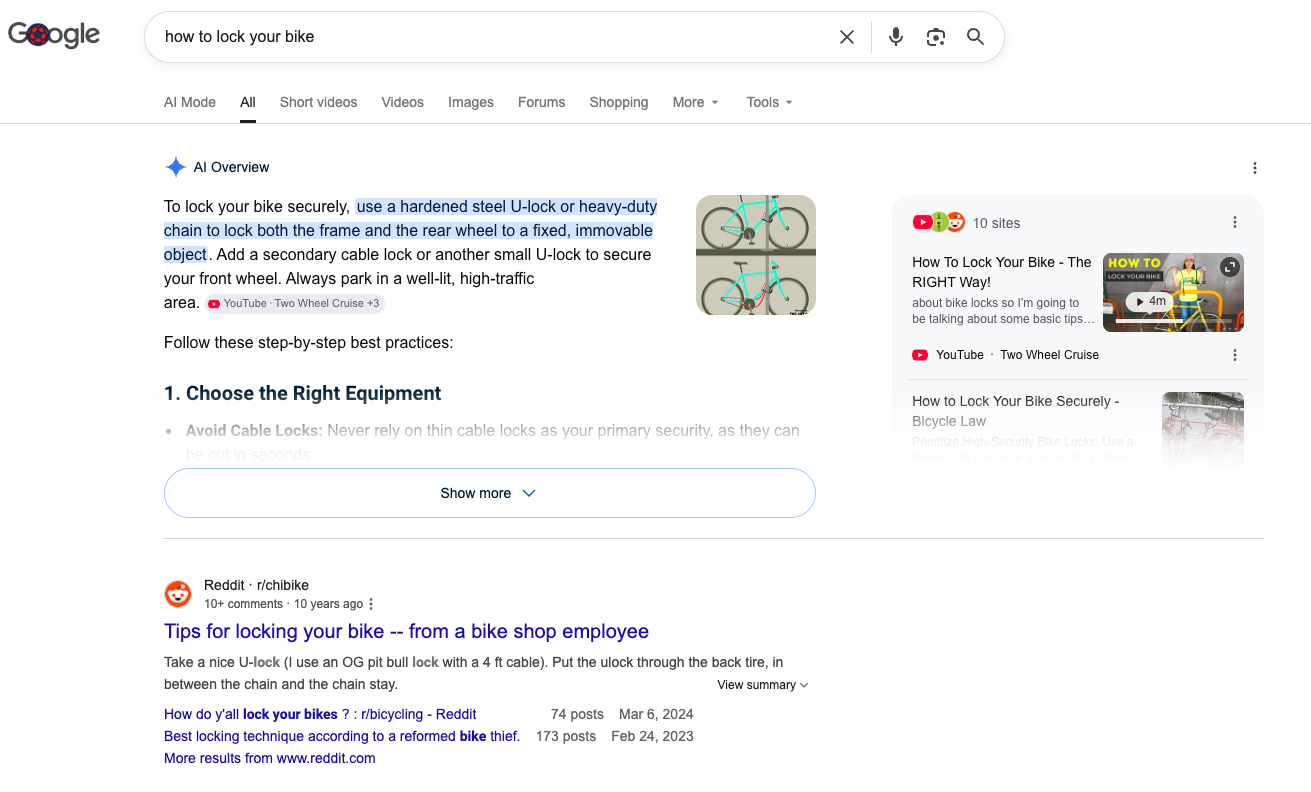
That’s the fingerprint of an AI Overview, a featured snippet, or another SERP feature answering the query right on the results page. A routine refresh won’t bring the clicks back because you didn’t lose rankings. You lost the click to the answer box.
3. Intent drift
Clicks down, position roughly holding, but the SERP around you changed shape. Google reinterpreted the query and now rewards a different format, like video, a comparison table, or a product page, and yours no longer matches. This one needs a human eye on the SERP. The numbers alone won’t flag it.
4. Demand decay (the imposter)
Clicks down, impressions down, but your position held or even improved. You didn’t lose anything. The topic is simply searched less. This is the one that fools teams into refreshing a page that was never coming back.
Dig deeper: Why more content is no longer a reliable way to grow SEO
How to tell them apart
You don’t need an expensive tool. You need Google Search Console and a spreadsheet.
Pull two things for each page: monthly organic clicks for the last six months, which give you the trend, and a three-month year-over-year comparison of clicks, impressions, and average position, which gives you the diagnosis.
Three months smooths out the noise, year-over-year comparisons cancel out seasonality, and the whole thing fits within GSC’s 16-month memory. A six-month year-over-year comparison would require 18 months of history Google doesn’t keep.
Then read the signature: the telltale way clicks, impressions, and average position move together. Each type of decay has its own signature. Match your page to the table below.
| Clicks | Impressions | Avg. position | Diagnosis |
| Down | Down | Worse | Ranking decay |
| Down | Flat or up | Stable or better | Zero-click capture |
| Down | Down | Held or better | Demand decay |
| Down | Varies | Holding, but SERP reshaped | Intent drift (confirm on the SERP) |
| Down site-wide, date-aligned | Down | Down | Algorithm update (different playbook) |
Before you act on any of it, run one check first. Did the drop start right after you edited the page? If it did, you probably didn’t catch decay. You caused it. Restore the previous version and compare before you pile a refresh on top of a self-inflicted wound.
One caution specific to this moment: Search Console impression data from 2025 is shaky for year-over-year analysis. First, in September 2025, Google removed the &num=100 parameter, which stripped out bot-inflated impressions and pulled counts down.
Months later, Google disclosed something bigger: a logging error had been inflating impressions since May 2025. It corrected the issue without repairing the historical numbers. Clicks were never affected.
So when a page looks like demand decay, with impressions down but position holding or improving, don’t trust the impression drop. Open the live SERP and look. If an AI Overview is sitting there, it’s zero-click capture wearing a demand-decay costume.
I built a Google Sheets version of this diagnostic. Paste in six months of clicks plus a year-over-year comparison, and it classifies the decay type and prioritizes pages by recoverable traffic. Use it as a starting point, then validate the results before acting.
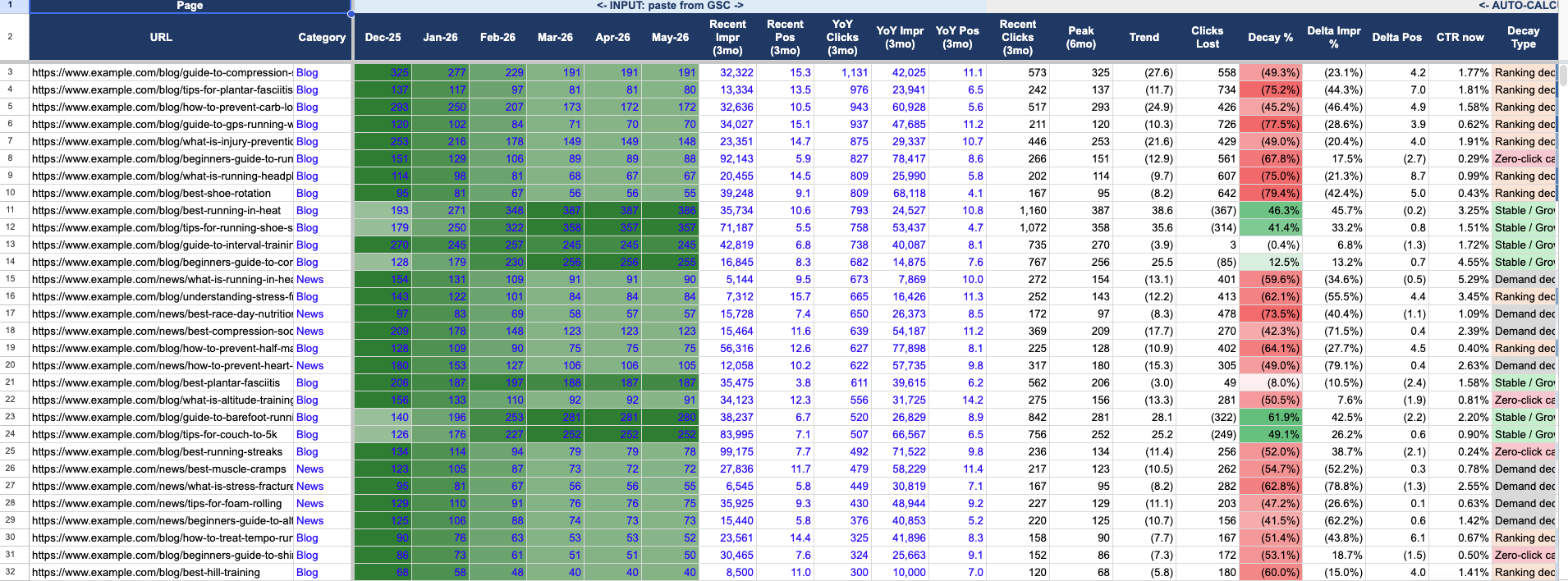
Want to take it further? GSC and a spreadsheet are the floor on purpose. Anyone can run that today, for free. Two upgrades make it even sharper:
- Add GA4: Conversions or revenue per page let you prioritize by what a page is actually worth, not just the clicks it lost. Engagement metrics help, too, because they often dip before clicks, giving you an earlier warning.
- Add a rank tracker and SERP feature data: These let you confirm zero-click capture across hundreds of pages at once instead of checking one result at a time.
Neither changes the diagnosis. They just measure it with finer instruments.
Dig deeper: How to keep your content fresh in the age of AI
The right fix for each diagnosis
Once you know the type, the fix gets specific. Here’s what each one looks like.
Ranking decay: The real refresh
In 2026, that means information gain, not a new date. Google’s guidance favors original, first-hand, people-first content, making cosmetic date swaps less useful than meaningful updates.
Picture a buyer’s guide that ranked third and slid to the bottom of page one after a competitor published a deeper version and earned links you didn’t. Adding 300 words won’t move it. Focus on these moves:
- Add what the current winners cover and you don’t: Original testing, a data point only you have, or the follow-up question every other result ignores.
- Check who those winners are first: If a Reddit thread now holds your old spot, you’re up against a format Google chose to favor, so match that intent instead of trying to out-write an article.
- Consolidate any cannibalizing URLs into one: Rebuild the internal links that signal authority.
Zero-click capture: Stop competing with the summary
The pattern that throws people most is a page that ranks better and still loses clicks. I audited a high-intent money page that climbed from an average position of 19 to 11, with impressions up 10% and clicks down by half. The reflex is a quick refresh.
That won’t work because you didn’t lose rankings or quality. An AI Overview is now answering the query on the results page. Recovering value takes a different play. Part of it is still real work on the page.
- Upgrade the page into something the answer box can’t replace: Original data, a calculator, a tool, or a genuine point of view. This is work on the content itself, not a date-and-paragraph refresh.
- Make the page a quotable source: That same unique value, plus clean structure, gives the page a better chance of being cited in an AI Overview or used by answer engines, where ranking on page one no longer means you’re the source being quoted.
- Know when the click is gone, and reallocate your effort: Some of these queries may never send a click again. Move your effort to a nearby page closer to conversion, like a service or comparison page, that people still click.
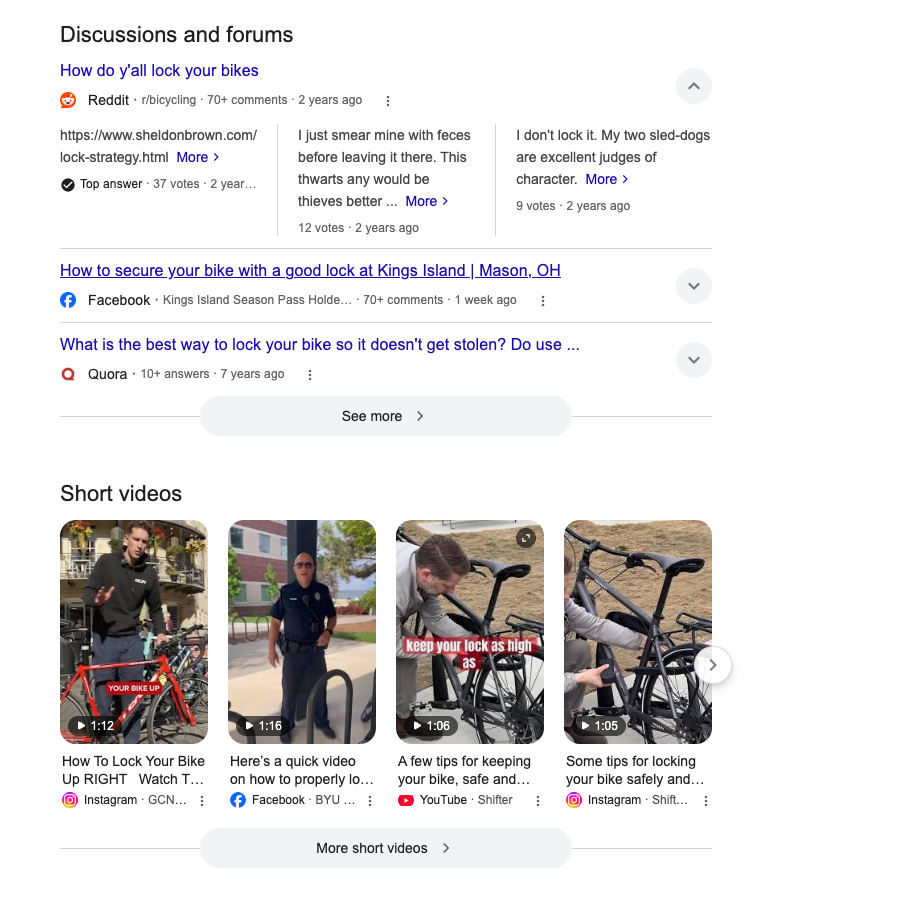
- Follow the audience off Google: If demand has moved to Reddit or YouTube, meet it there by creating content for those platforms. That’s a separate effort, not an update to this page.
Dig deeper: What replaces the ultimate guide in AI search
Intent drift: Re-match the format
When Google reinterprets a query, the winning format changes, and a technically strong page that no longer fits gets left behind.
A “best [product]” search that used to surface buying guides might now return product pages. A how-to might now lead with video.
If you published a narrative guide where the SERP wants a comparison table, content quality is irrelevant. The format is wrong.
- Re-match the format the SERP now rewards, or split the page into the versions it’s asking for.
- Keep the URL so you don’t lose its equity.
- Recheck quarterly, not just once. The SERP is more volatile than it has been in years, with video carousels, forum blocks, and product modules surfacing and disappearing on the same query.
Demand decay: Usually, do nothing to the content
An old news article that spiked around an event and faded, or a guide for a product nobody buys anymore, isn’t coming back, and no rewrite resurrects a search people stopped running.
First confirm the demand is really gone, not just relocated. A falling Google Trends line doesn’t always mean demand disappeared. It may mean some of that behavior moved to AI assistants, social search, forums, or video platforms.
- If the topic still has an audience elsewhere, the play is to build a presence on that surface, not refresh the page.
- If it’s genuinely gone, consolidate it into a broader page that still has demand, redirect it, or prune it.
Prune without guilt. If a page is outdated, unhelpful, and has no recoverable demand, keeping it may add noise instead of value. Google has long advised removing or improving unhelpful content when it no longer serves users.
Dig deeper: Refreshing content: How to update old content to drive new traffic
The mistakes that look like strategy
Most wasted refresh effort traces back to a handful of reflexes:
- Treating every drop as a content problem. This is the core error the whole framework exists to prevent.
- Changing the publish date with nothing behind it. Readers and Google both see through it.
- Padding word count. Length was never the ranking factor. Thoroughness was.
- Refreshing a demand problem. No amount of editing recovers a topic people stopped searching for.
- Refreshing too often to measure anything. Give a change a quarter to prove itself before you touch it again.
- Refreshing a page you broke. If traffic fell right after an edit, restore it. Don’t rewrite it.
See where your brand appears, where it doesn’t, and exactly how to win more visibility across search, AI, local, social, and every channel that matters.
Make it a habit, not a fire drill
The teams that stay ahead of decay don’t wait for a page to lose 80%. They run a quarterly sweep. Tag every slipping page by type, sort by recoverable traffic and business value, and act only where the diagnosis says action will work.
As zero-click results keep climbing, that discipline matters even more. The advantage no longer belongs to whoever refreshes the most pages. It belongs to whoever knows which pages are worth refreshing and which ones to leave alone.
Key takeaways:
- Diagnose before you refresh. Falling clicks have at least four causes, and only one is fixed by rewriting. Identify the type first.
- Watch impressions and position, not just clicks. Clicks tell you a page is decaying. Impressions and position tell you why. Rising impressions with falling clicks point to zero-click capture, not a content problem.
- Know when not to act. Demand decay and “I broke it myself” pages don’t need a refresh. They need a different decision. Refreshing them wastes time and budget.
- Confirm ambiguous cases on the live SERP. Especially after num=100, a demand-decay pattern with improving position is often an AI Overview in disguise.
- Systematize it. A quarterly, signature-based decay sweep beats reactive, one-off rewrites every time.
Dig deeper: How to revise your old content for AI search optimization
Topics on this page
If you liked the article, do not forget to share it with your friends. Follow us on Google News too, click on the star and choose us from your favorites.
If you want to read more like this article, you can visit our Technology category.