
Table of Contents
Creating fewer, more purposeful pages can improve relevance, reduce duplication, and strengthen local search performance.
Publishing more pages doesn’t automatically build topical authority. In many local SEO projects, the bigger challenge is deciding which queries deserve their own pages. Getting that decision right can strengthen relevance, reduce content overlap, and improve search performance.
The ‘Query Deserves a Page’ framework
“Process all the attributes of an entity” and “process all the variations of a query template” are the two simplest ways to explain how topical authority works for local or location-agnostic SEO projects.
If a project is primarily about “rehab,” one way is to process each type of addiction along with every relevant attribute. Another is to identify a query template, such as “Can X cause addiction?” and process all its variations.
In both cases, we rely on a core metric called Query Deserves a Page (QDP). QDP is inspired by Query Deserves Freshness (QDF), a concept introduced by former Google engineer Amit Singhal.
Below is an example site from this case study and its results. The project operates in the luxury rehab industry and is based in Southeast Asia. It needs to rank for the “rehab [country name]” query template to generate leads while also ranking for variations such as “best rehab,” “x addiction,” “x addiction treatment,” “x rehab,” and “rehab [country name].”

The project successfully uses both approaches for topical authority, as it processes all the possible attributes of an entity and all the variations of certain query templates. Google’s ranking decision tree uses basic machine learning algorithms and works as follows.
- If a site satisfies the “Can X cause [Y] addiction” query, it can possibly satisfy the “Can [C] cause [D] addiction” query too. Google performs a small click test, and if the click test result is positive, it makes the website more rankable for the specific query template based on query similarity.
- If a site satisfies the queries from a certain entity-context pair, with certain attribute combinations and verbalizations, it can do the same for other entities from the same class. This helps the website rank better both initially and during the re-ranking phases.
- Google tends to trust a website through satisfied clicks or historical data. If the site exploits this search engine trust by performing parasite SEO, going after irrelevant topics, or publishing lower-quality content, the earlier decision tree can be altered to a lower initial and re-ranking scale during a re-ranking, and the positive ranking state can be erased.
This brings a question to the center of local and location-agnostic SEO campaigns: Which query template variations and which entity-attribute pairs deserve a page?
I explained the QDP concept during an iGaming SEO conference using the slide below. If we create a query search taxonomy, from “holster” to “Nylon OWB Glock 19 Gen 4 5.2 Inch Holster,” there are 17 steps between the canonical and represented queries. Do we need to open 17 different pages?

The same question applies to local SEO projects. If you’re a car accident attorney in California, do you need to open a web page for every city, district, and type of accident? That would mean at least 300 pages.
If you open all of them, can you use the same templated, similar, or repeated sentences, paragraphs, lists, tables, images, and structured data samples, or do you need to make them more unique?
Track, grow, and measure your visibility across Google, AI search, social, local, and every channel that influences buying decisions.
Core concepts for building topical authority
Let’s explain some concepts first. Then we’ll examine more than seven different websites by sharing their transparent data and, in most cases, their names.
Query Deserves a Page
Topical authority isn’t only about writing simple blog articles or for programmatic and templatic projects that cover more topics.
It’s a “cost-of-retrieval” optimization for search engines: satisfying the needs behind a query with click satisfaction while spending less computational effort.
Some queries deserve representation at the page level. Others deserve it at the heading, sentence, table, list, form, calculator, converter, product filter-like visual annotation, or many other possible levels.
The most important representation decision comes from the “Page or Not” question because every unnecessary page increases the cost of retrieval.
Topical authority is defined as “historical data multiplied by topical coverage,” divided by “cost of retrieval,” and finally “interpreted with visual semantics.”
Detecting near-duplicate pages according to search queries
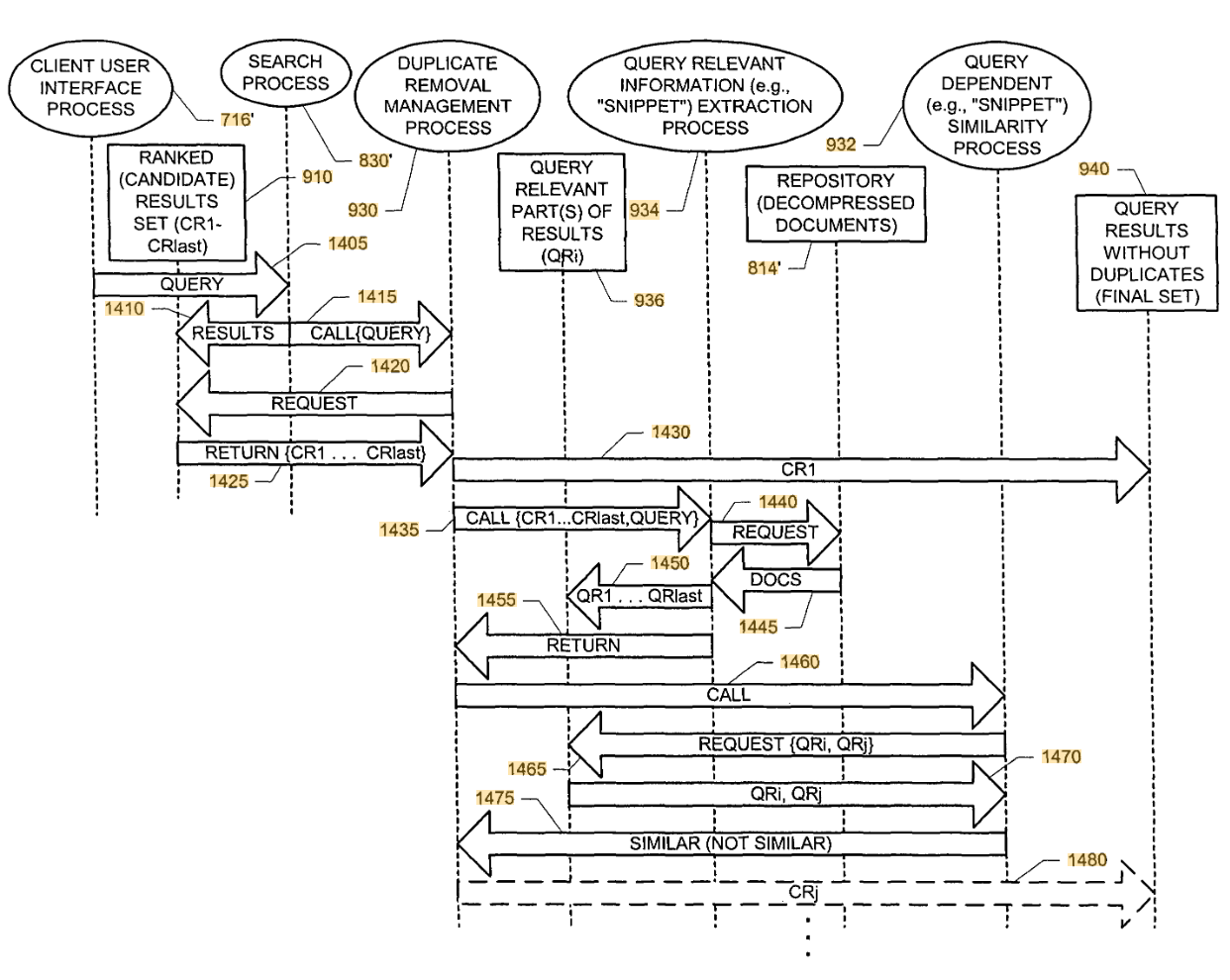
The patent, “Detecting query-specific duplicate documents,” explains how Google can sometimes see two documents as “exact duplicates,” sometimes as “near-duplicates,” and sometimes as “fully unique,” because every page becomes repetitive or unique according to the query that makes it necessary in Google’s index.
Having a level of “overlap” helps relate documents to each other, especially for justifying internal links and “link descriptions,” meaning anchor text. But if the overlap exceeds the threshold, documents become near or exact duplicates.

Google constructs an index. SEO creates a page.
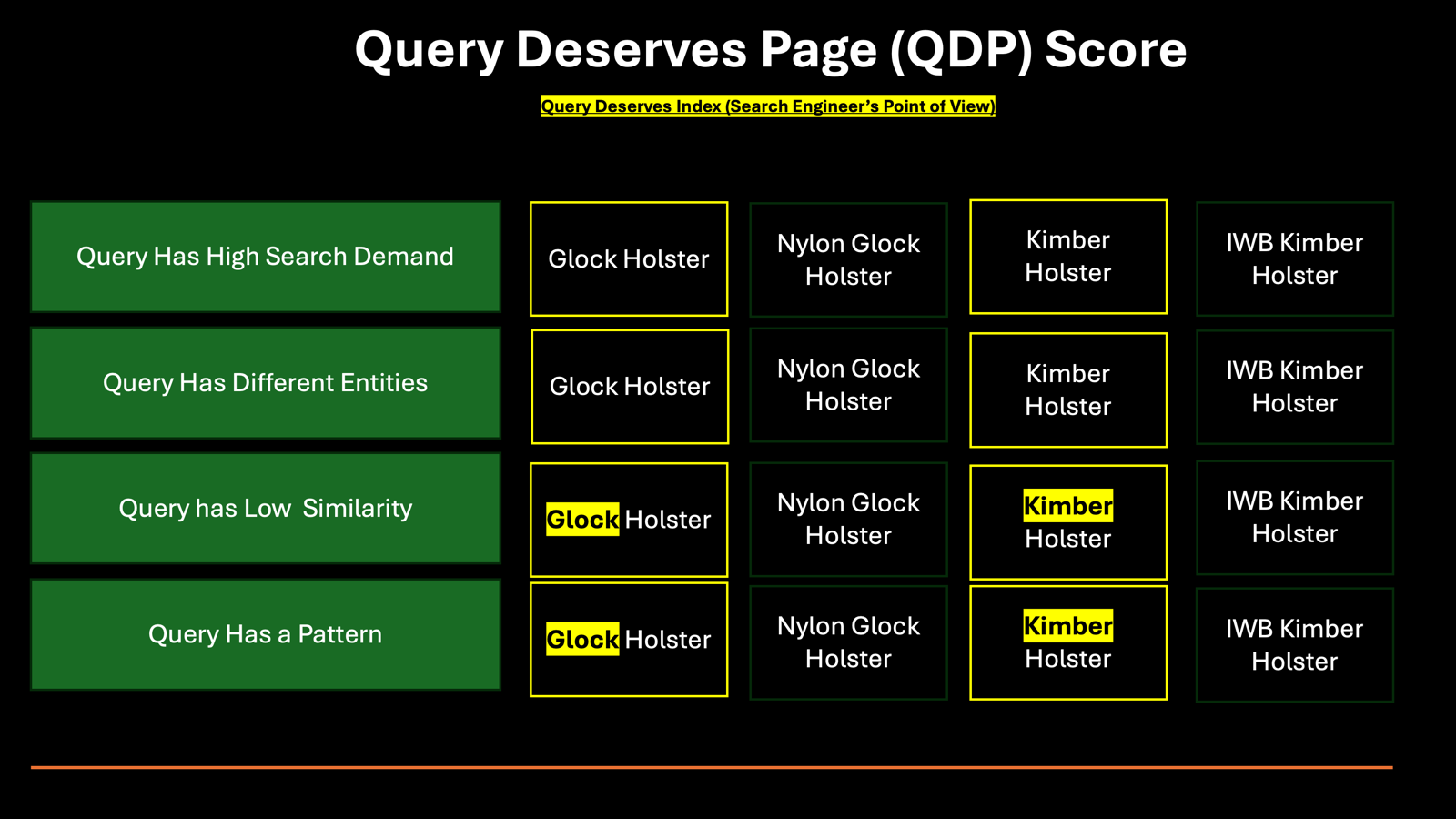
From “Glock Holster” to “Glock 18 Holster” and other variations, there’s always a level of duplication. Whether these variations deserve separate pages depends on four metrics:
- The query has high search demand.
- The query has different entities.
- The query has low similarity.
- The query has a pattern.
If certain metrics are met, these variations can become separate pages in the topical map. Otherwise, they should exist as different sections on the same page, represented through visual semantics such as headings, sentences, product cards, or information cards.
These metrics help an SEO process a query the way a search engine does because search engines essentially ask: “Should we create an index for this query?”
An SEO asks a different question: “Should we create a page for this query?”
Whenever Google creates an index, we create a page for indexing. If you parse the query incorrectly, you’ll dilute your ranking signals by causing micro-cannibalization.
To better understand Google’s indexing tiers and decision trees, read the “Index server architecture using tiered and sharded phrase posting lists” patent. Also, review what Gary Illyes explained about indexing tiers and shards during the Search Off the Record podcast.
You can’t fully grasp Google’s ranking decision tree for local or location-agnostic SEO without understanding how Google parses queries and constructs indexes.

Query Deserves a Page in practice
Below are exercises for deciding whether a query deserves its own page, progressing from easier to more difficult.
“Glock Holster” and “Nylon Glock Holster” have the same entities. Only “Glock Holster” is highlighted with yellow corners to indicate that it has a unique entity, while the second query doesn’t.
If “Nylon Glock Holster” doesn’t have enough search demand, it isn’t highlighted. “Nylon Glock Holster” can exist as a subsection under the “Glock Holster” page rather than deserving its own page.
Here’s a similar comparison between the “IWB Kimber Holster” and “Kimber Holster” queries.
Below, the query networks for “Glock 19,” “Glock 20,” and “Glock 21” are processed under the same web page, while “Glock 18” and “Glock 18X” are processed as separate pages.
The highlighted corners indicate why. “Glock 19,” “Glock 20,” and “Glock 21” don’t have enough search demand, and they’re excessively similar queries.
This raises a question. If “Glock 18” and “Glock 18X” aren’t considered similar, why are “Glock 19,” “Glock 20,” and “Glock 21” considered similar?
Query similarity isn’t calculated using basic string similarity. It’s a weighted similarity based on the importance of the entity and search demand.

Another research paper, “End-to-end query term weighting” from Michael Bendersky and Marc Najork’s team, shows how BERT weights the “Nike running shoes” query, treating “Nike” as more important for relevance than “running” or “shoes.”
In this case, similarity between queries is calculated based on term weights, informed by natural language processing and how Google-like search engines construct indices.
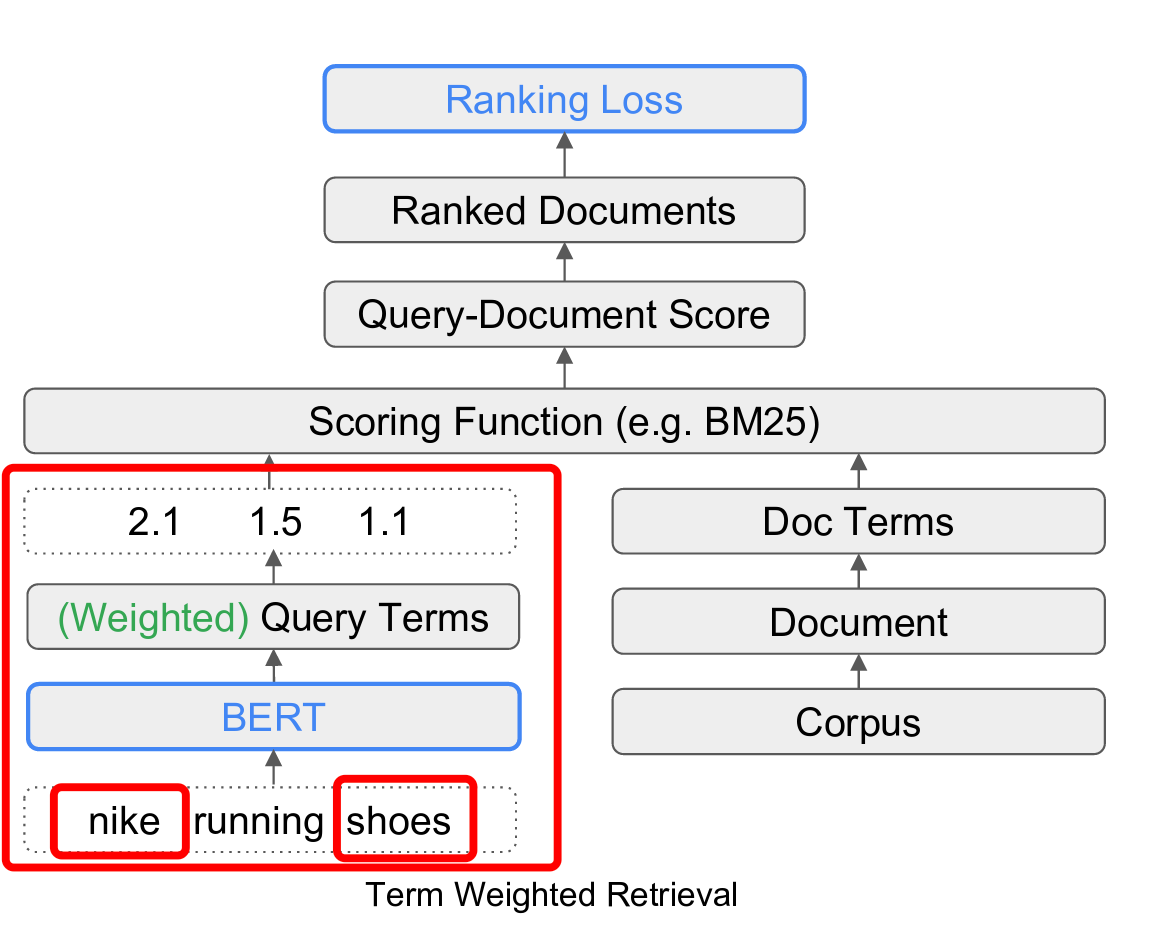
If “Nike” is the heaviest term in this query, the created web document should also weight “Nike” more heavily in its vocabulary, triples, and annotations. For example, the subject of the triples should contain “Nike.”
If “running” were the heaviest term, it would change the entire topical map, sentence structure, and triples. Similarly, without understanding the weight of “Los Angeles” in the query “Los Angeles Car Accident Attorney,” we can’t process the query and decide whether it deserves its own page.
Below is another example involving cross-brand products. Here, we multiply the product query by the brand entity because search demand is high enough, while the “query has different entities,” “query has low similarity,” and “query has a pattern” metrics all exceed their thresholds. Since three of the four metrics are satisfied, these queries can become new pages.

The “query has low similarity” metric isn’t approved because “1911” is the highest-weighted query term, and it exists in every query. As a result, these queries don’t pass the threshold for that metric.
The “query has a pattern” metric is always marked approved because these products all have attribute queries such as “price,” “review,” “problems,” “solutions,” “repair,” and “maintenance,” either as interrogative queries or incomplete query phrases.

Not all these metrics are based primarily on the query. Google sometimes constructs a new index because of the nature of the document clusters. For example, the PageRank of the ranking documents or the size of the document cluster can cause a search engine to construct a new index.
In both cases, a high-PageRank document cluster with a large number of URLs should have a uniform vocabulary. If the vocabularies differ too much, Google might distribute the documents to other existing indices for different queries.

If Google created an index based solely on search demand-related or derived metrics, it would miss a significant amount of information and opportunities to satisfy queries driven by sudden needs or less popular topics. Based on index size, index PageRank, and index vocabulary, it can still construct new indices.
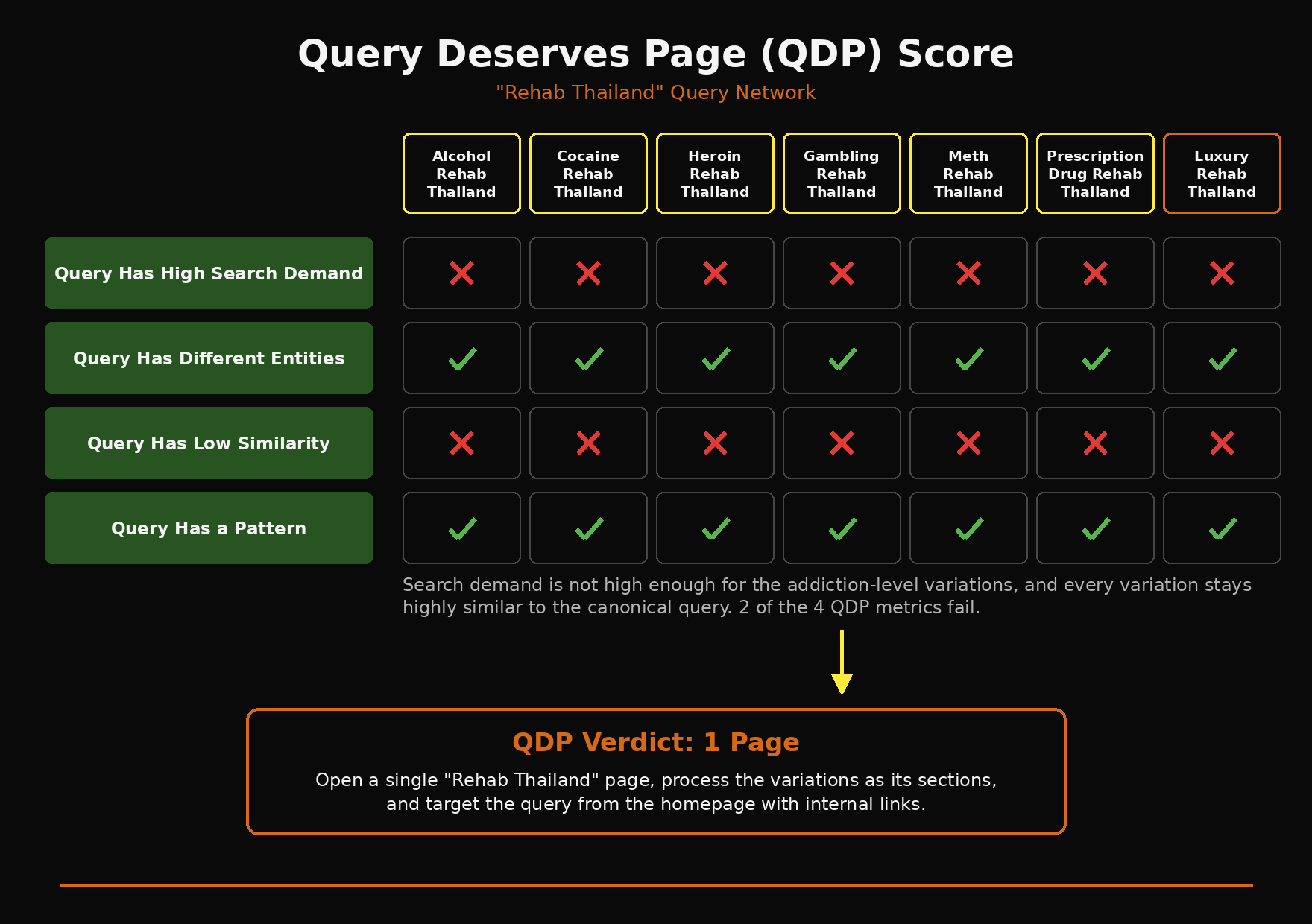
Now, before moving to the other case study projects, let’s apply this logic to our “Rehab [Country]” example.
Why should the homepage target the most important location-service pair?
In my local SEO projects, I follow one rule: The most important location-service pair should be targeted from the most important page, usually the homepage. This can be amplified by a partial- or exact-match domain or site name.
The site name isn’t the same as the domain name. Google treats it as part of your brand name, and it doesn’t have to match your domain.

Most of the time, the homepage is the strongest page because it has the highest PageRank, and after your robots.txt file, it’s usually the most crawled page by search engine crawlers.
For the “rehab Thailand” query network, the queries have high similarity, and the variations don’t have enough search demand. Thus, we’re opening a single page, and since this is the most important query network, it should be targeted from the homepage.
In many local SEO projects, the homepage, About page, or main service pages cannibalize each other because PageRank, query relevance, click data (historical data), and the Google Business Profile website URL are some of the main contributors to rankings, and they’re shared by multiple pages.
Here are the third-party results from Ahrefs and Semrush. Semrush shows higher rankings because it includes Google Business Profile rankings, while Ahrefs doesn’t.

The last two years of Semrush results are below.

Before moving into the page design and page content necessities, to better explain the Query Deserves a Page principle for forming a topical map, check another live example below.
An incident and injury attorney website/brand from Melbourne previously had around 19 different location-specific pages, and these pages were opened for very similar locations, such as “Melbourne Beach” and “Melbourne Center,” with certain service terms.
The query similarity and query search demand criteria aren’t met for any subdistrict or neighborhood of Melbourne.

After we merged these unnecessary [service] + [location] landing pages, the initial results for both the Google Business Profile and the website improved greatly.
More than 232 new queries came in, and 60 queries gained better rankings. If the website used a homepage with an exact- or partial-match domain name or site name, it could amplify these improvements even further.

Here are some of these monetary query terms and their values.

How visual semantics play a role in local SEO and topical authority
Visual semantics are based on Google’s visual annotations, such as the “center-piece annotation.” They help identify the main function and purpose of a web document. A web document doesn’t consist of text alone. It’s defined by how that text is presented and how the presentation satisfies query needs.
In local SEO projects, processing a query with its location and service attributes, then distributing those attributes across the web document, carries great importance.
Below are the micro- and macro-context segments of a homepage in which every subsegment carries a function and matches an augmented query.
Query augmentation is a system for processing a query and representing it within a bigger context. What Google publicly calls “query fan-out” is technically query augmentation in its patents.
Query augmentation is also a patent name that comes directly from Anand Shukla, who also worked on “Search with stateful chat,” the patent behind Google’s AI Overviews and AI Mode.
In other words, if you understand how Google augments a query, you can build a better contextual vector for the page and optimize its layout accordingly.

“A representation of the Query Augmentation from Anand Shukla of Google”.
The table below shows how the canonical query “rehab thailand” can be augmented.
| Query augmentation | Visual semantics (Figure Component) | Triples (Subject – Predicate – Object) | Named entities |
| find a rehab thailand, book rehab thailand | 2 – Hero with H1 “Drug and Alcohol Rehab in Thailand” + CTA “Talk to us – free and confidential” | ({Rehab Name}, is a, Rehab Centre), ({Rehab Name}, located in, Thailand), (User, contacts, {Rehab Name}) | {Rehab Name}, Thailand |
| rehab thailand for foreigners, rehab in thailand from uk | 1 – Utility bar with regional phone chips (UK, US, AU, HK, TH) | ({Rehab Name}, serves, United Kingdom), ({Rehab Name}, serves, United States), ({Rehab Name}, serves, Australia) | United Kingdom, United States, Australia, Hong Kong, Thailand |
| licensed rehab thailand, accredited rehab thailand | 3 – Evidence strips: “{Accreditation Body} + licensed by {Health Authority}” and logo pills {Prof. Association}, {Addiction Assoc.}, {Accreditation}, {Cert. Body} | ({Rehab Name}, licensed by, {Health Authority}), ({Rehab Name}, certified under, {Accreditation Body}), (Staff, member of, {Prof. Association}) | {Health Authority}, {Accreditation Body}, {Prof. Association}, {Cert. Body}, Thailand |
| reviews for rehab thailand, is rehab in thailand safe | 4 – Review carousel “H2: Rehab in Thailand – {Rehab Name} Reviews” with {Reviewer 1}, {Reviewer 2}, {Reviewer 3}, star ratings, Google badge | ({Reviewer 1}, rates, {Rehab Name}), ({Rehab Name}, has rating, 5 Stars), (Review, verified by, Google) | {Rehab Name}, {Reviewer 1}, {Reviewer 2}, {Reviewer 3}, Google |
| rehab chiang mai, rehab resort thailand | 5 – Definitional block: “{Rehab Name} is a luxury rehab centre in {City}, Thailand…” + proof line “7000+ successful recoveries, {Landmark} location” | ({Rehab Name}, is a, Luxury Rehab Centre), ({Rehab Name}, located in, {City}), ({Rehab Name}, situated on, {Landmark}), ({Rehab Name}, has recovery count, 7000+) | {Rehab Name}, {City}, {Landmark}, Thailand |
| best rehab therapist thailand, rehab counsellor thailand | 6 – Therapist carousel with named practitioner entities (Dr. A. Example, B. Example MSc…) | ({Therapist}, works at, {Rehab Name}), ({Therapist}, has credential, MSc), ({Therapist}, specializes in, CBT) | {Rehab Name}, therapist person entities |
| cocaine rehab thailand, ketamine rehab thailand, alcohol rehab thailand | 7 – Tabbed micro context selector “What We Treat” with active Ketamine tab and definitional snippet | ({Rehab Name}, treats, Ketamine Addiction), (Ketamine Abuse, may lead to, Cognitive Decline), (Tab, links to, /ketamine-addiction-treatment/) | {Rehab Name}, Alcohol, Cocaine, Heroin, GHB, Ketamine |
| rehab thailand cost, how much is rehab in thailand | 8 – Mid-page conversion band with form “I’m ready for a change” + “Privacy protected, 24h reply” | (Enquiry, protected by, Privacy Policy), ({Rehab Name}, responds within, 24 Hours), (User, submits, Enquiry) | {Rehab Name} |
| meth rehab thailand, gambling addiction thailand, trauma treatment thailand | 9 – Programme card grid, 8 contextual bridges with anchor texts matching child page H1s | ({Rehab Name}, offers, Meth Addiction Programme), ({Rehab Name}, offers, Gambling Programme), (Card, links to, Child Page) | {Rehab Name}, Meth, Gambling, Trauma, PTSD |
| medical detox thailand, aftercare rehab thailand | 10 – Process accordions in treatment order: Medical Withdrawal, Residential Programme, Aftercare | (Programme, starts with, Medical Withdrawal), (Programme, followed by, Residential Treatment), (Programme, ends with, Aftercare) | {Rehab Name}, Medical Withdrawal, Aftercare |
| luxury rehab thailand, best rehab thailand | 11 – Vertical tab attribute verbalizer: Luxury Rehab Care, Asia’s Rehab Hub, Premium Facilities, Integrated Team | ({Rehab Name}, has care type, Luxury Rehab Care), ({Rehab Name}, positioned as, Asia’s Rehab Hub), ({Rehab Name}, has, Premium Facilities) | {Rehab Name}, Asia |
| how long is rehab in thailand, rehab thailand what to expect | 12 – Tabbed FAQ accordion: “Q: How long does the alcohol rehab program last at {Rehab Name}?” | ({Programme Name}, has duration, 4 to 12 Weeks), (Duration, depends on, Individual Needs), (Answer, aligned with, PAA) | {Rehab Name}, Alcohol |
After augmenting the query, we distribute the resulting entity-attribute-context triples across the subsections of the web document, expressing each one through a specific visual component or engagement element.
The example below shows a live website whose layout is modeled on this query augmentation logic.

Since this case study mainly focuses on the intersection of local SEO and topical authority, I’ll leave this detailed infographic for your examination and move on to the next points.
In my web documents, the content is divided into macro context and micro context, a distinction that parallels Google’s Quality Rater Guidelines, which separate content into “main content” and “supplementary content.”
Most of the time, internal links are distributed within the micro context, while the macro context carries the “center-piece annotation” that represents the purpose and primary engagement point of the web document.
The page here curates opinionated, factual, structured, and unstructured content together. For example, users can read and submit reviews, send questions directly to the rehab specialists, or complete a poll to learn the likely treatment duration and requirements for their situation.
Once we’re certain that a specific topical map, its content briefs, and the layout modeling work, we can scale them to secondary websites.
Here’s a secondary website with the same homepage design, which continues to generate click growth even though its older informational sections are outdated and have lost their initial rankings.

Topical authority for location-specific queries without physical offices
Some local SEO projects are performed mainly for SaaS, real estate projects, cruise ships, train itineraries, hospitals, allergists, and similar businesses. Rather than ranking as a brick-and-mortar business, we sometimes rank as a software or aggregator brand across various locations. The example below is a project I haven’t published before: Doktorsitesi.com, an aggregator for doctors and hospitals.
The problem with the website is a classic one: It opened millions of unnecessary pages for every city, district, hospital, hospital department, doctor, and doctor’s clinic. Let’s say you search for a doctor named “Ahmet Yılmaz.” There are more than 2,000 doctors with the same name. When you search for “cancer treatment,” the company has more than 40,000 pages that can target the query.
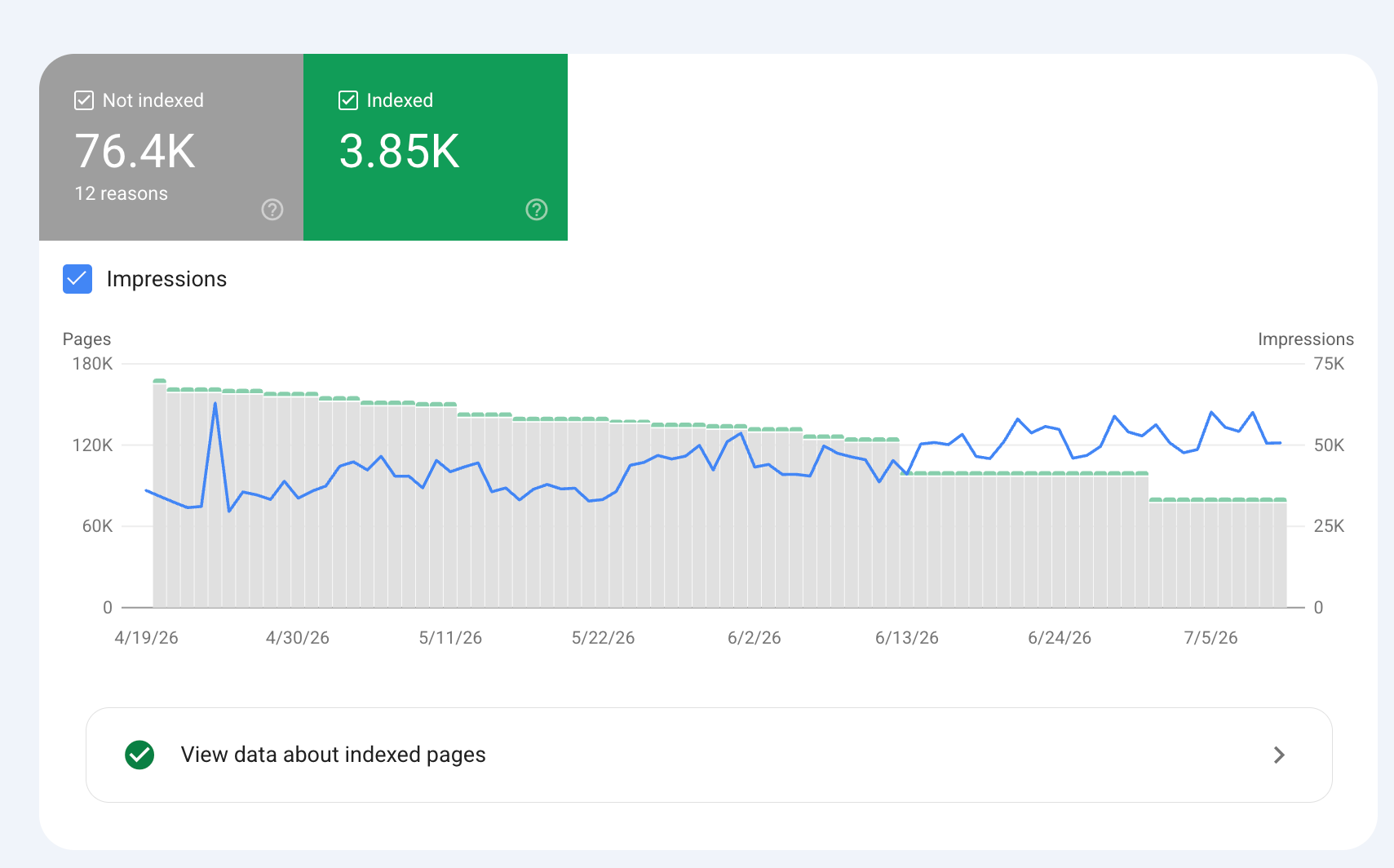
That’s why I mentioned Google’s SERP diversification and query-specific duplicate documents patent. The website initially had 4,000,000 documents that weren’t indexed by Google, and the indexed ones were also mostly duplicated. This decreases the ranking signal per document while increasing the computational cost of understanding the website, creating millions of micro-cannibalizations.
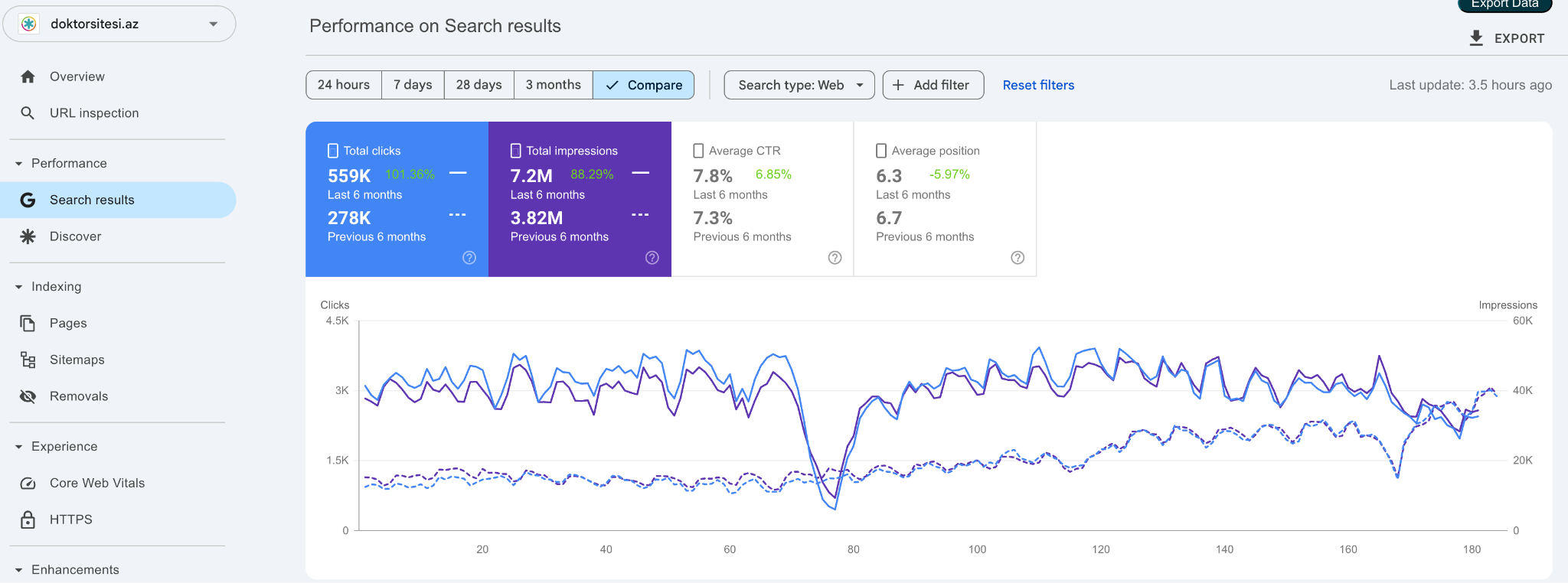
Here are the initial results just after deleting unnecessary documents. It brought 600,000 additional clicks while keeping impressions the same, based mainly on the technical changes.

Many local SEO projects don’t calculate the relevance confusion between web documents when Google can’t find enough reasons to index a specific location-based page.
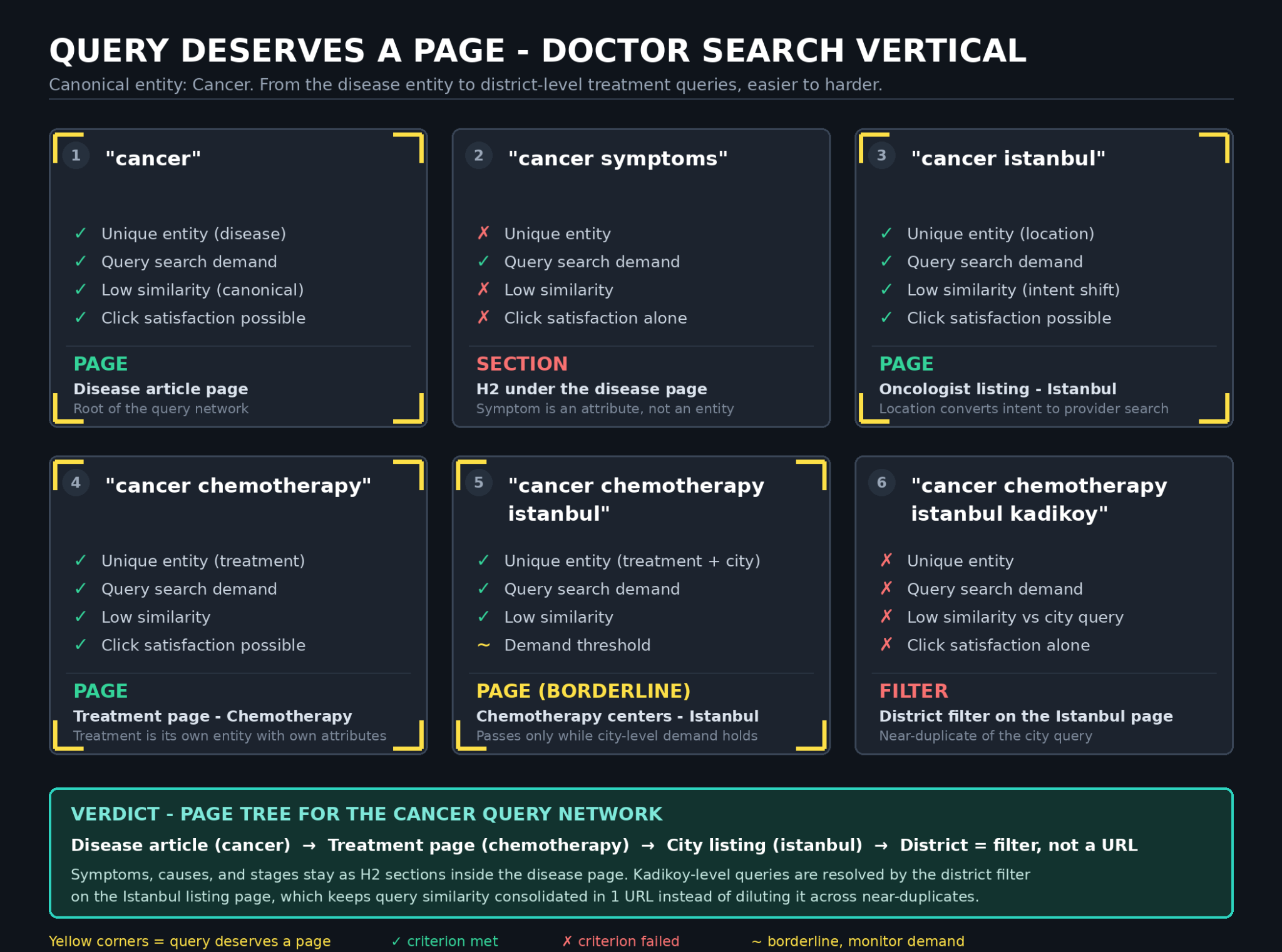
For example, Doktorsitesi.com has more than 40,000 pages related to “cancer,” but which one is the most relevant? Which one is most relevant to “cancer + symptoms” or “cancer + treatments”? Which one is most relevant to “cancer + treatments + Istanbul”?
To get a snapshot of relevance-based listings from your site, use a Programmable Search Engine created only for your website. You can also use it to compare your pages against each other, or add three or more competitor websites and see how Google prioritizes them for relevance because the website that performs better in Google’s evaluation will provide most of the first 20 results.
Here’s how pages from different periods repeat each other because of the different doctors’ cancer-related articles. In addition, there are many repeated “cancer hospital in [city]” pages related to the root query “cancer.”

Some of the cancer-related, city-based hospital and doctor search pages are also represented below as the result of the “site:[sitename] intitle:[disease name]” search template.

These two screenshots demonstrate that more than 40,000 documents are near-duplicates based solely on the query “cancer.”
Below is a snapshot of the Google Search Console Pages report from before we started pruning the website’s unnecessary segments. It shows large “Crawled – currently not indexed” and “Discovered – currently not indexed” segments, which are clear signs of a lack of quality and unique, original main content for queries that deserve an index from Google Search.

The “Discovered – currently not indexed” segment might be the most important sign of insufficient quality for any type of project, local or location-agnostic, in Google Search Console.

Below is the internal link distribution of a programmatic local SEO project, which is mostly wrong. The only accurate section here is the homepage because it’s the most important page and should target the most important query, as I explained earlier.
However, most of the other highly linked pages are completely irrelevant to the other important query networks, which hurts PageRank distribution and signals the importance of a web document to Google in the wrong way.

A local SEO project should target its most important query from the homepage while channeling most ranking signals and importance qualifiers to it. The homepage should then link back to the most important quality pages, which I call “quality nodes,” because Google predicts a website’s quality from the internal links on the homepage.
As Martin Splitt explains, when Google’s crawler reaches more unique, original, human-effort documents from the homepage, it’s convinced to crawl deeper and evaluate the website more favorably.
Google’s page quality prediction system relies on internal links, which is why we link our most important quality pages directly from the homepage. In the homepage mock-up design from the rehab example earlier, the contextual bridges are adjusted solely for this purpose.
For local or location-agnostic projects, track these four core KPI metrics:
- Maintain an HTML crawl rate of at least 99%.
- Keep the combined crawl rate of 200 and 304 status codes at 99% or higher.
- Keep the discovery rate above 20%.
- Direct 100% of HTML crawls exclusively to indexable URLs that return a 200 status code and appear in both the sitemap and internal links.

I always compare the crawl rate per HTML document to see how many days need to pass for Google to crawl my entire website end to end. As an important note, check your raw log files to see your full crawl data because Google Search Console provides only around 30% of the actual crawl log data.
Also, Google has different crawling purposes, meaning not every crawl is equal. Google can sometimes crawl a site only to check status codes, refresh caches, or recognize entities. The higher the crawl rate, the more Google cares about the site.
For example, below you can see a section from my CMSEO speech featuring a quote from Pandu Nayak, Google’s chief of ranking, and his statement from the Google antitrust lawsuit.
He directly states that if a document doesn’t deserve it, they don’t run the expensive algorithms for these websites. Instead, they check core topicality and locality signals.

Here’s a better example. RankBrain is an expensive algorithm. Thus, if a website isn’t worth it, this expensive algorithm doesn’t run for it.

That’s why I suggest targeting the most important query network from the most important page with an exact-match or partial-match domain. This way, you earn click signals earlier, and if you satisfy those clicks, Google runs its expensive algorithms for your website sooner.
In my previous case study, I gave audiototext.com as an example. If you examine the graphic below carefully, you can recognize one absolute fact.
Our page, content, design, and everything else remain 100% identical whether we receive five clicks a day or 8,000 clicks a day. Sometimes the website loses 60% of its clicks, but after every broad core algorithm update, it comes back stronger.
Google performs click tests, and if the click signals demonstrate satisfaction while visual and textual semantics are implemented properly, the website can outrank even the biggest enterprises like Veed.io, Cleedo, and ElevenLabs, all without a single backlink.
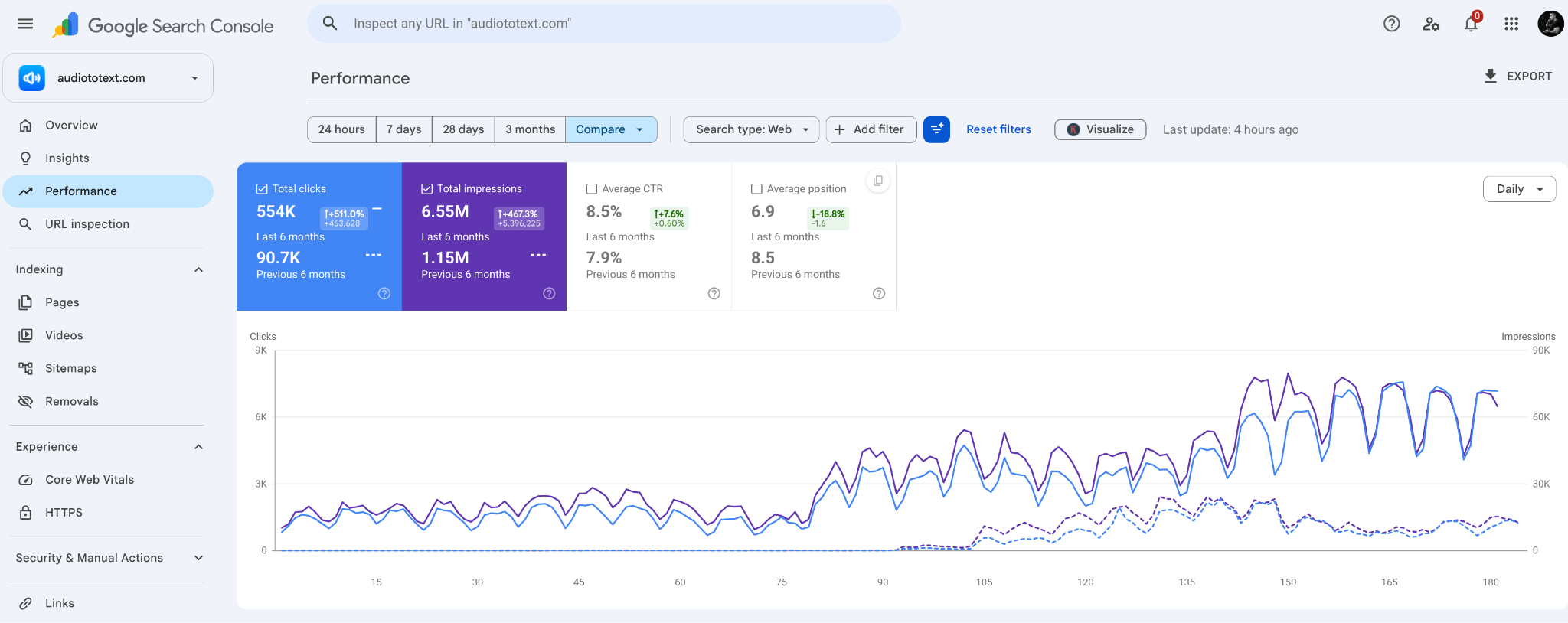
Google’s Content Warehouse API leak module “RankLabTitle” has attributes like “baseRank” and “testRank,” which annotate how Google slowly extends its trust in a website by performing re-rankings across different broad core algorithm updates.

To prevent ranking signal dilution across all the pages targeting the canonical query “cancer,” there should be one comprehensively optimized web document, both textually and visually, that ranks for the concept and transfers its relevance to the location-specific pages.
In other words, a location-agnostic page for the concept can lift the rankings of the location-specific pages. The visual semantics implemented after the query augmentation are shown below.

Many local SEO projects forget the subdomains or microservices they leave open, and Google keeps crawling these unnecessary subdomains, whose content quality also impacts Google’s judgment of your website.
Thus, if a subdomain isn’t necessary, remove it and redirect it to the main domain using Google’s Change of Address tool. If it is necessary, disallow it for Googlebot, but keep it functioning behind the scenes.

Below, you’ll find the results for the extension domain of the same project for Azerbaijan with the same implementation from a content pruning, ranking signal consolidation, and content (visual and textual semantics) perspective.

Here’s the six-month difference during this process.
Here’s the Query Deserves a Page exercise for the cancer-related queries and their augmented variations.
The exact same approach can be seen in another location-specific programmatic ranking project, this time for yacht chartering, a non-brick-and-mortar business that needs to rank for location-specific queries.
We decreased the number of pages by resolving many unnecessary query-specific duplicates and removing pages that don’t have a query to trigger an index on Google’s end.
In this cleanup, we removed pages targeting queries like “[model] yacht charter [city] [district]” that lack a sufficient level of query search demand, entity prominence, and uniqueness.
Here are the results during this process: a 248% click increase, a 37% impression increase, and a 29% average position improvement.

The direct results from the last six months, taken from a first-party data source, are shown below. Feel free to examine them together with the possible spam, core, or unannounced quality updates.

The Query Deserves a Page exercise for the same context is below.

Do links from local news sources improve location-based rankings?
Yes, exact-match or partial-match domains carrying the city or district name provide a ranking advantage if they serve semantically related and responsive documents. The project below is the third example of location-specific rankings without a physical location. Its name is Ucuzabilet, which operates in the flight ticket industry.
To rank aggressively for “flight ticket [location],” locale-based news sources are used for the “how to book” and “how to find the cheapest” query templates. This means there’s an external topical map targeting the variations of these specific query templates while providing internal links to the entity-attribute pair pages.
This Google Search Console report shows the impact of this external topical map, optimized with co-occurrences and certain types of claims to influence consensus on the web for both the AI answers of LLMs and web-indexing search engines.

These are the results from the last six months.
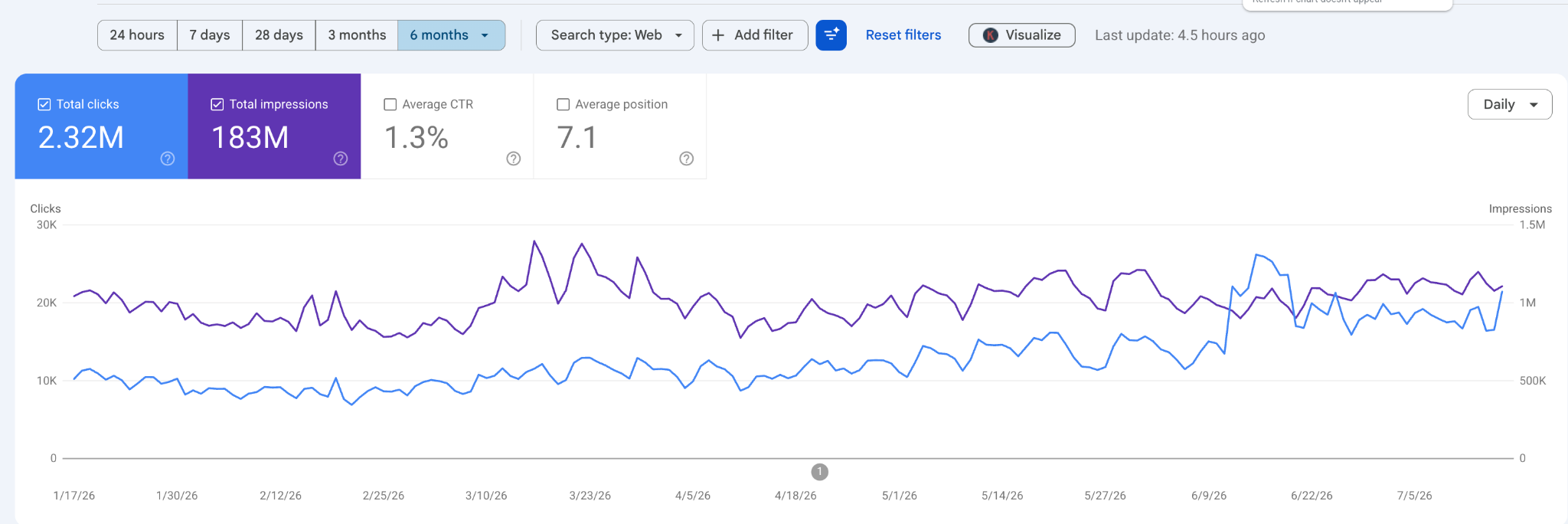
And here are the city-level differences for the “flight ticket + location” queries.
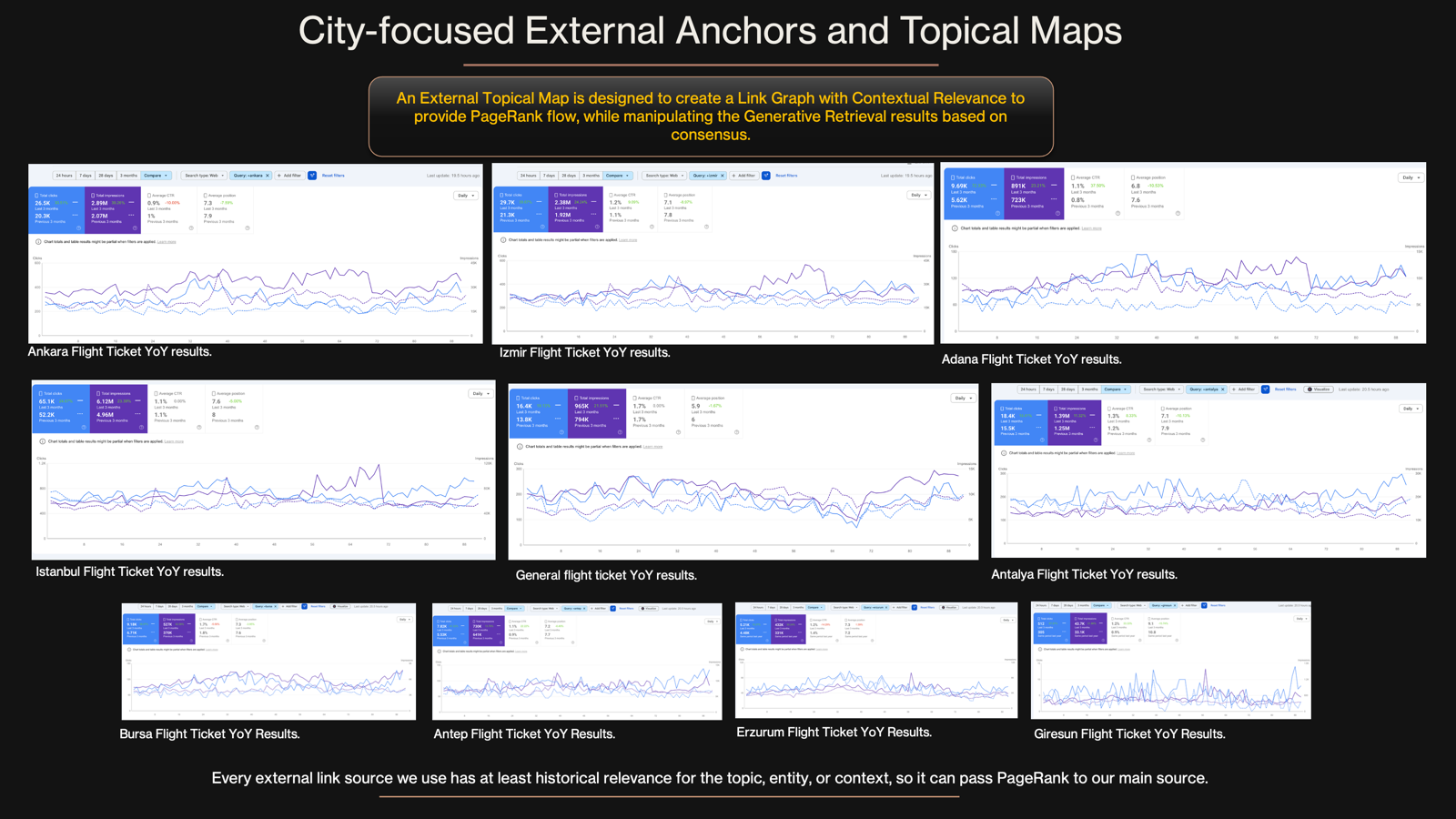
As explained earlier, you can see that we keep cleaning various non-indexed and indexed documents based on the Query Deserves a Page principle because the site’s main problem was having multiple pages for every city and every city-to-city route, such as “New York City to Erzurum,” when technically only 50 people a year might search for flight tickets on this non-existent route.

This context should be just a segment under another page to rank, yet the website previously even had pages for cities that don’t have an airport. If we opened a page for every possible route on the planet, it would create millions of unnecessary pages without a single query that deserves an index on Google’s end.
An example Query Deserves a Page exercise for the flight ticket context is below. For instance, “direct flights to Istanbul” sits on the borderline. There is search demand, but since “Istanbul” is the heaviest term in the query, the similarity metric won’t exceed the related threshold.

The same logic is applied to a hotel aggregator with exactly the same internal, external, and technical implementation. The external topical map with exact-match and partial-match news sources is implemented for the hotel project below.
For both winter and summer tourism, the city-level and nationwide location-specific queries have shown between 30% and 120% year-over-year click increases.

The year-over-year performance comparison mainly for “thermal hotels,” along with the holiday season results, shows one with a 27% click increase and the other with a 411% click increase.

Check the link graph example for the case study project, which mostly comes from travel and tourism websites, as it should, but also includes news sources with tourism and travel sections linking from related sections.
Another necessity in semantic link graph construction is using foreign-language websites according to the tourists’ homeland and the specific cities they visit.
For example, if British people mostly visit Antalya from Manchester, using Manchester-based news websites with anchors mainly for “Antalya hotels” or “all inclusive Antalya hotels” is a helpful direction in terms of NavBoost principles.

The six-month results, along with the Query Deserves a Page-related page-cleaning results, are below.

The hotel aggregator here opens many unnecessary district and hotel-type pages, along with parameterized query results. The majority of real estate, tourism, or Doktorsitesi.com-like websites use the “?parameter” URL structure, which forces Google into a huge level of computational consumption for canonicalization and URL consolidation.

Cleaning these parameters and having a non-crawlable filtering system is a priority for these types of websites to communicate with search engines.
Technically, “example.com/location/service?parameter=value” should be represented either as “example.com/location/service#value” or, without any URL change, the presented content should be modified directly by user preferences. Every parameterized URL that can’t be indexed contributes to retrieval cost and ranking signal dilution.
Here’s the AI-related citation data for the project, in which more than 16,000 pages are cited by various generative search systems.

One of the reasons for this is the optimized and verbalized structured information cards. As explained in the visual semantics SEO case study, Google reads documents not only as text, but also as structured information cards.
The annotations existing in these cards are verbalized so information can be extracted and interpreted through agentic retrieval.
With this logic, here’s a verbalization matrix showing how many declarations, facts, claims, and actions can be extracted, annotated, interpreted, and used through the hotel cards.
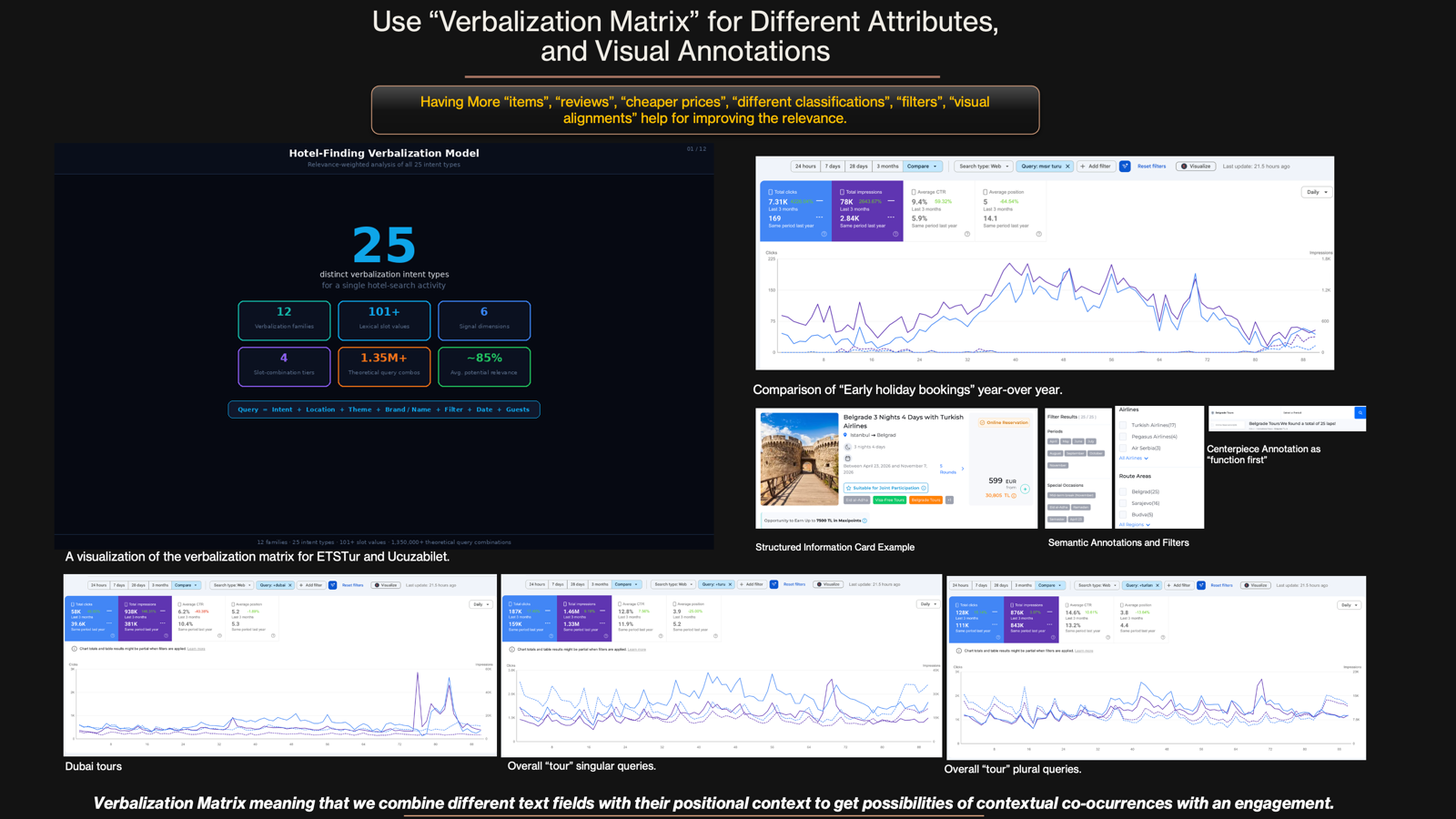
Having more structured information cards for a wider range of entities from a specific class, in this case hotels, along with more reviews, meaning user-generated unique content for these entities, and enriched comparisons between them, is a major factor for ranking in a certain locale and category pair.
Google’s layout-aware document understanding patent explains how ranking algorithms can classify and judge a page based on the information it stores in pixelized form.

You can observe a Query Deserves a Page exercise for the hotel context below.

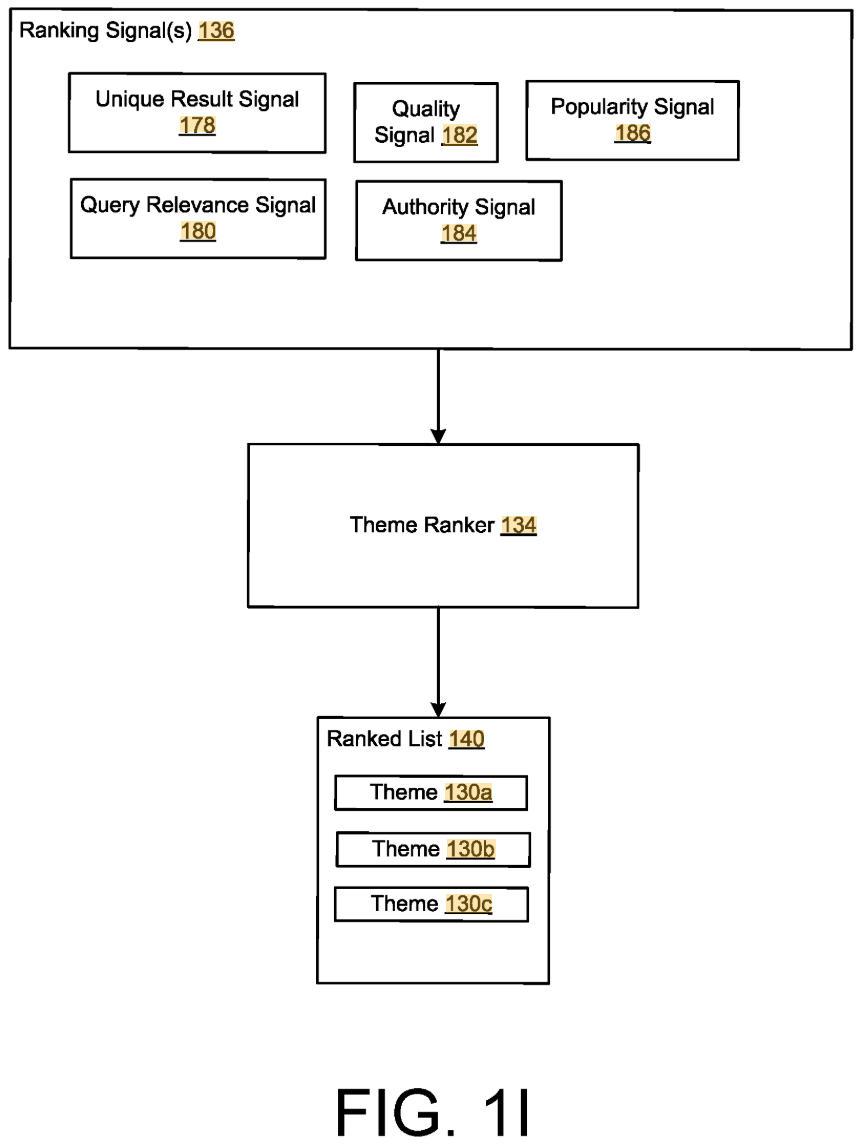
The patent explains how Google can classify documents according to query themes and generate different sets of ranking criteria for each.
A query theme basically represents the context of the query, and Google previously used a sidebar to represent these different themes.

An example of theme clustering for a seed query is shown below from an earlier Google A/B test on the “electricity” query.
Technically, a web source that ranks for every possible theme and context of the “electricity” query gains higher topical authority, and the same logic applies to locality and service pairs.

Google balances some of the ranking signals according to the main theme of the query. For example, for some queries, popularity becomes more important, while for others, query relevance or quality carries more weight.
When we ask for the “best milk,” Google runs a chain of reasoning across different types of themes and contexts and creates multiple possible listicles.
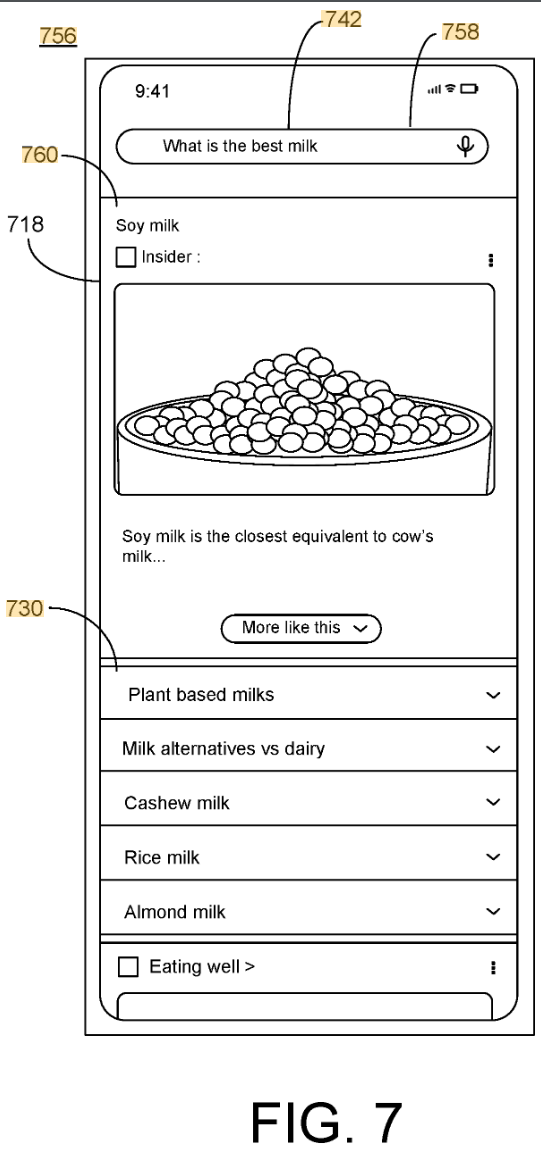
A level of this chain of reasoning is visible below. For example, it suggests that to determine the “best milk,” allergy becomes an important attribute, which triggers a new theme.

This patent is important for understanding item ranking because when you rank hotels, flight tickets, doctors, allergists, real estate ads, cruise ship itineraries, hair transplant clinics, or epoxy flooring companies, the list and the service qualification you provide have to make sense to the search engine’s chain of reasoning.
The external topical maps we create amplify consensus and confidence around the most important attributes. Thus, these surround-sound campaigns aren’t only for links and PageRank. They’re mainly for claims and co-occurrences.
Can an external topical map with certain attribute assignments help Google Business Profiles rank higher?
Yes, an external topical map can help a local SEO project rank better by providing a stronger and more permanent link graph. External topical maps create logical connections between domains by making the link-source page rank for certain related query terms, which passes quality, click, and historical data signals to the link-target page through Google’s NavBoost factor.
Consensus building with third-party sources is an important part of agentic retrieval and ranking through a chain of reasoning.
In other words, when a question like “Who is the best attorney in Houston for personal injury cases?” is asked, Google or any chain-of-reasoning-based LLM system has to justify its answer by parsing the question into attributes.
The assignment of these attributes and their relevance to the brand entity help the brand’s Google Business Profile and its overall entitization rank better. Here’s an example of an external topical map along with its results.
The initial Google Business Profile-related ranking increases are shown below.

To show the importance of this ranking increase, you can see the traffic cost, which is more than $3,000,000.

The snapshot of the external topical map shows the publication frequency, topic, domain, anchor text, annotational text, quality of the published document, and whether the topic aligns with both the linking and linked domains are the most important factors.
The domains should also align with each other because all these websites are indirectly connected to each other as a link graph.

Above, you can see that skillsyouneed.com links to a law firm through “Skills to Be a Lawyer,” pickuptrucktalk.com links through “Truck Accident Lawyer,” and futureofthings.com links through “Evidence Evaluation and Technology.”
The important note here is that all these queries and topics pass the Query Deserves a Page test. For the same project, you can see how query augmentation and visual semantics were implemented earlier.

Below is an example of extracting the most important attributes of a service provider in a certain location. Simply ask Google AI Mode a question like, “What are the most important attributes for [occupation] in [location]?”

As a next step, ask Google AI Mode, “What are the best [service providers] in [city] based on [attribute], [attribute], [attribute]?”
If you use a simple automation, you’ll see that when you change the attribute combinations, Google checks a different index, and every index, or “theme,” has a different set of criteria.
If your external topical map is aligned with these attribute combinations, you can increase your chances of being selected as an item in both map and web rankings.
The table below presents the entities that own these attributes, the predicates to use, the contextual phrases, and the measurement units for these attributes. To understand the concept of contextual phrases, read Google’s phrase-based indexing system from Anna Patterson. There are good phrases and bad phrases to include with certain co-occurrences, and exaggerating the co-occurrences will increase the Gibberish Score.
| Entities | Predicates | Contextual Phrases | Measurement Unit or Signs |
| Attorney | Is certified in | Personal injury trial law | Board Certification (Yes / No) |
| Attorney | Has proven | Track record of winning trial verdicts vs. settling | Number of jury verdicts won |
| Law Firm | Is capitalized to | Fund expensive upfront expert witnesses | Available capital (USD $) |
| Attorney | Focuses on | Motor vehicle collision cases daily | % of caseload dedicated to accidents |
| Fee Structure | Is driven by | Contingency models (“no win, no fee”) | 0% upfront / % of final settlement |
| Attorney | Understands deeply | Insurance bad faith and policy limits | Years of insurance litigation experience |
| Attorney | Is fluent in | Specific county courts, local judges, and venues | Local court appearances per year |
| Attorney | Is connected to | Top accident reconstructionists and medical experts | Size of expert witness network |
| Attorney | Comprehends | Long-term traumatic medical needs and prognosis | Medical report literacy score (High/Low) |
| Attorney | Is accessible for | Direct client communication rather than assistants | Hours of direct attorney access |
| Law Firm | Maintains | Low caseloads by rejecting mass-marketing | Active cases per attorney |
| Attorney | Negotiates against | Lowball insurance company settlement offers | Settlement multiplier vs. initial offer |
| Attorney | Secures quickly | Electronic black box data and video footage | Days to secure critical evidence |
| Attorney | Adheres to | Strict legal and filing statutes of limitation | Missed legal deadlines (Zero) |
| Attorney | Is respected by | Fellow local attorneys and judges | Peer rating tier (e.g., AV Preeminent) |
| Attorney | Maintains record with | State licensing bar association | Disciplinary actions / Grievances (Zero) |
| Attorney | Provides realistic | Case valuations instead of inflated promises | Accuracy % of initial vs. final recovery |
| Attorney | Negotiates down | Outstanding subrogation and medical liens | % reduction in outstanding medical debt |
| Attorney | Communicates with | Persuasion in front of a live jury | Jury trial win-rate percentage |
| Attorney | Cross-references | Meticulous details in police and medical reports | Discrepancies identified per case file |
The Gibberish Score is a concept that exists in both Google’s patents and Google’s Content Warehouse API leak.

How to design city pages with informational aspects for seasonal queries
The example site here is mainly about allergies, and it achieved a 42% year-over-year click increase during pollen season by focusing only on the “pollen forecasting and calendar in [city]” query template. City-level pages for a certain attribute, such as “pollen allergy,” require a topical map with the main sections below.
- Allergy types
- Individual allergy types, such as fish allergy or milk allergy
- Allergy treatments
- Pollen types
- Tree types
- Allergist in [city]
- Pollen calendar in [city]
All these pages internally link to each other, and every document we update, whether technically, layout-wise, or text-wise, contributes to freshness and improved quality signals, while the historically satisfied click signals pass to the other connected pages.
Query similarity helps machine learning algorithms operate on the logic that if a website satisfies queries for “allergy types” and “pollen types,” it can similarly satisfy “allergist in [city]” and “pollen calendar in [city].” To save computational cost, search engines tend to rank the more central sources around a certain topic.
Rather than ranking 999 different websites for similar queries, ranking a central authority source and changing its ranking status from one core update to another is relatively cheaper and more stable for the ranking algorithms.

Context-wise, the “pollen calendar” page mainly has a calendar demonstrating the severity of pollen types for allergy types, month by month and type by type, for the cities and subdistricts at the same time. The city pages also link to an engaging “find an allergist in [city]” page.
The center-piece annotation of the web document is strongly the calendar component, with the internal link component for finding an allergist attached through a map component.
Here’s the represented visual semantics of the calendar pages, along with their visual alignment and the anatomy of their annotations.

The doctor page’s results are below, demonstrating more than a 23% click increase along with a 23% average position improvement.
In all these pages, there is a semantic web component we call a “topical entry grid,” which always links the quality nodes at the very bottom of the web document. Above that, wherever the allergist is located, we link the subdistricts or neighboring districts with EMAs (exact-match anchors) while providing context.
These office or clinic pages need certain annotations. Providing information alone isn’t good enough. Google has ranked functional pages since the Helpful Content Update because “helpful” means functional.
In other words, if a web document doesn’t have a reserve, sell, calculate, convert, compare, or similar function, and there is no center-piece annotation signaling these functions, ranking for these types of queries becomes harder.

Here’s how we imitate the “book an appointment” functionality on the web document. The last missing part in these pages is, technically, the verbalization, meaning the documents should verbalize the working hours, doctor biography, doctor background, doctor address, doctor expertise, valid insurances, doctor reviews, and doctor questions and answers.
These components are being added to the website gradually while a new CMS is designed and developed because Shopify Liquid theme files have limitations.

In these projects, most of the time, the root of a semantic content network starts with a “[term] near me” page, while the [city] and other locale hierarchies come under it according to the Query Deserves a Page principle. A Query Deserves a Page exercise for this project is below.
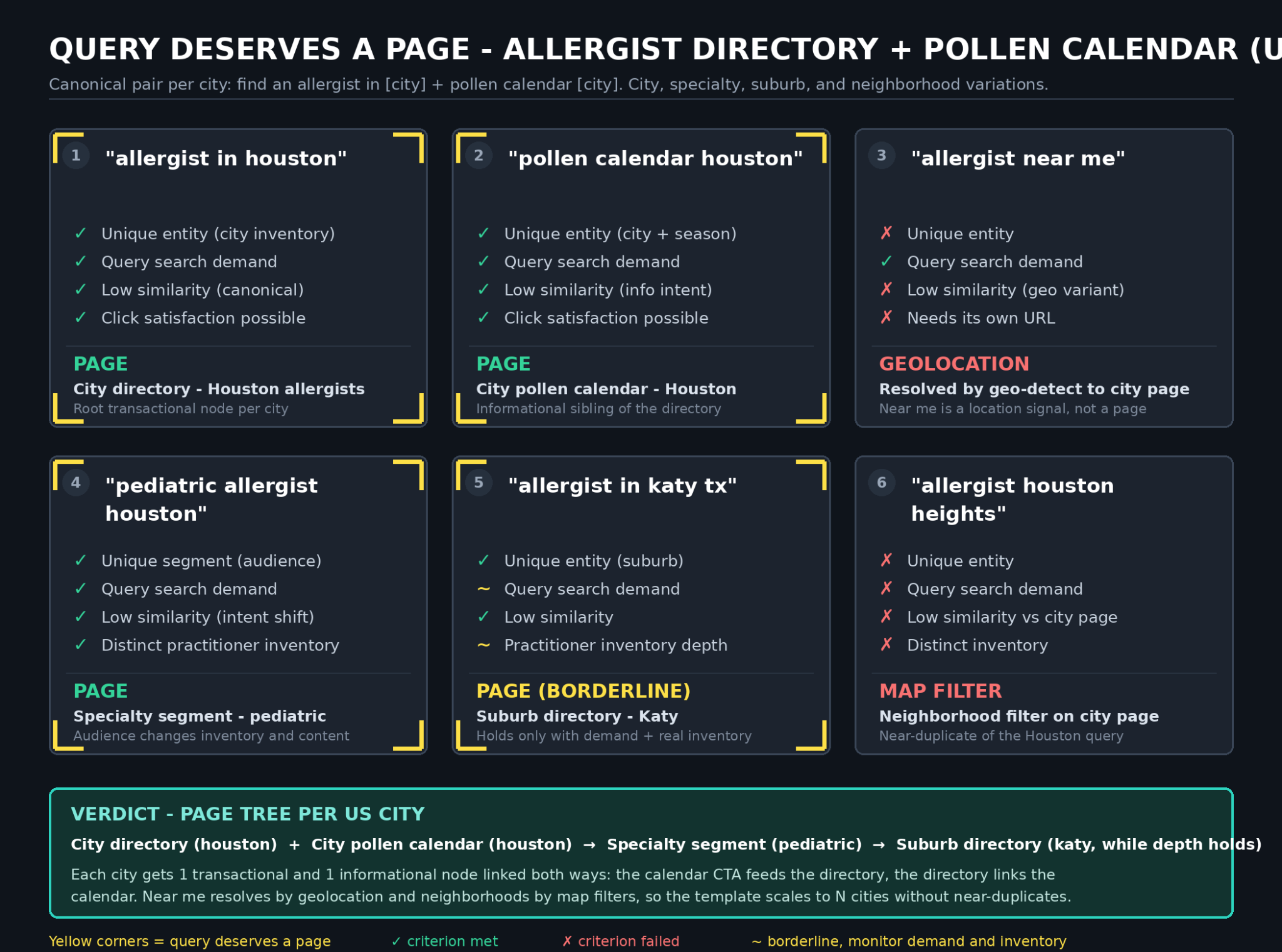
How to design and create location-specific store or office pages
A second example of an office or multiple-location company brand is Oscar Wylee. Oscar Wylee is a successful premium eyewear brand operating in Australia, Canada, and New Zealand, and its subscription glasses are the main product line, which makes the “optometrist” queries more important.
If you have an optometrist-approved prescription, you can get sunglasses or eyewear with government support. This makes “eye anatomy,” “eye health,” and “eyewear” subjects, along with fashion topics like “face shape,” “frame types,” and “glasses and outfit matching,” central to our topical map.
But to rank for queries like “optometrist in [city]” or “eye test in [city],” we need a certain level of information-connected, actionable, and functional store pages.
Unlike the previous allergy case study, in this project we have multiple different types of Google Business Profiles. Thus, our map components come from Google Business Profile-attached iframes.
The most important Google Business Profile is embedded on the homepage, while the other Google Business Profiles are placed into their own specifically matching web documents.
For Oscar Wylee, mainly the location-specific and “optometrist near me” queries are targeted with the design and mock-up below. You can compare the similarities between the allergy-context case study and the optometrist-near-me context.

Here’s the comparison between Ahrefs and Semrush for the /locations segment. Because Ahrefs doesn’t include Google Business Profile rankings, only Semrush shows the combined effect for Australia. Similar results and structures were also seen for Canada and New Zealand.

Below are the third-party Semrush results for the location-specific pages.

You can observe the Query Deserves a Page principle for the project below.

Can exact-match subdomains rank better than the main domain for a specific locale?
Yes, in certain cases, a website can outperform its main domain with the help of an exact-match domain contribution, along with the advantage of a smaller site size and not inheriting the effects of spam updates.
We repurposed an expired domain with established authority and regional relevance to the United States: Lexinter. The main domain didn’t rank as it should, but when we used the subdomain with the phrase “attorneys,” it started to rank better for the “[occupation] attorneys in [X]” queries.
Google might not transfer the historical authority and click-satisfaction signals of an expired domain to its new owner, while a subdomain with exact-match domain terminology can avoid these filters.
Here are the results for attorneys.lexinter.net from Ahrefs and Semrush.

Regarding the relevance threshold, if you can’t change your domain name or create a subdomain, test the site name update approach shown below. QRFY.com successfully updated its site name to “QR Code Generator,” which helps it rank better for the “QR Code Generator” queries.

You can also find “SiteNameFactor” as a ranking contributor in Google’s Content Warehouse API leak. But we can focus on exact-match domains and how Google balances their ranking signals in a later article.

Lexinter mainly ranks for the “best attorneys in [city]” query template across different law disciplines, and its listicles can impact the AI answers of LLMs by contributing to the consensus. The Lexinter listicles are kept in the form of structured information cards with a minimum of text to better emphasize the listicle itself.

The second example in this category is Pricelisto.com, a price-listing company covering different types of local businesses, such as restaurants, in nearly every state and city in the United States.
The company was hit by Google’s Helpful (Functional) Content System and its updates, and it was able to recover when we moved the same content and design into subdomains with exact-match domain terms, dividing one large website into smaller chunks.
Here are the results from Google Search Console and Semrush.

The main problem for the company was ranking for the menu prices of various restaurants without being able to offer food ordering. Thus, Google replaced the price-listing directories with location-specific restaurant review, comparison, and food delivery services because these are real-world businesses that aren’t easy to imitate with AI.
Another factor contributing to the positive re-ranking is that we were able to add user-generated content, restaurant price comparison, restaurant price intelligence and analytics, a menu AI assistant, data-set sales, and food ordering functionality through affiliate partnerships. Adding these functions helped us recover the local query rankings and indexing.

Here’s the Query Deserves a Page exercise for Pricelisto, along with its visual semantics representation.

The visual semantics mock-up shows explanations for Pricelisto.

How to rank for a locality with a service page without being there
This is the last combination type for local SEO: having a brick-and-mortar business with a Google Business Profile, but not being located where you’re trying to rank, in this case, another country.
Technically, “hair transplant Turkey” is a query as competitive as those in the iGaming industry. We have two example sites you can compare: Longevita and Vera Clinic. For one, we repurposed the homepage. For the other, we created a new landing page in a subfolder.
Here are the results of Longevita’s new webpage, which ranks No. 1 for “hair transplant Turkey” in the United Kingdom.

Here’s an example content brief, web component, mock-up design, topical map, and its live version, along with the initial Google Search Console results and AI and web rankings, all in a single snapshot in case you want to examine them more closely.
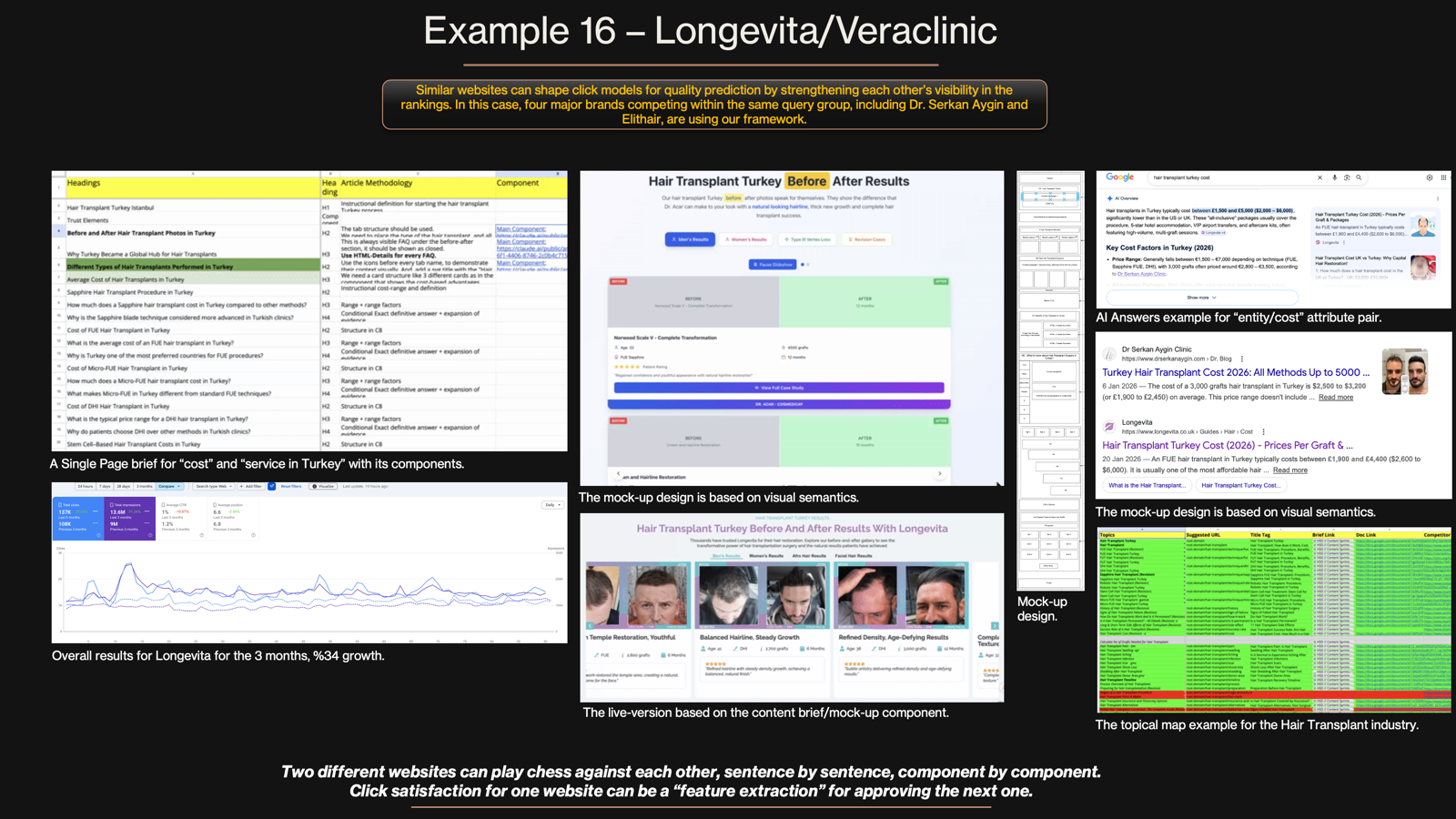
In particular, the component below is the center-piece annotation element that represents, visualizes, and verbalizes all the possible query augmentations for “hair transplant Turkey,” improving relevance and responsiveness together.

Here are the Semrush results.

The important thing here is knowing when to open a subpage for a specific hair transplant technique, when to open a subpage for a city in Turkey, and how to connect your core section of the topical map to the outer section with informational topics, as explained earlier in the hotel and flight ticket case studies.

The same approach was implemented similarly for the second website’s homepage, and you can compare the results. Here’s the mock-up and visual semantics comparison to correlate with the differences in results.

How to rank with a physical location for different brand names and non-physical locations at the same time
The example below is from the cruise ship and itineraries industry in the luxury segment, meaning a single click here can be worth more than $150,000. Thus, every incremental improvement in organic or non-organic performance is highly important.
One of the website’s main problems was publishing too many pages for search engines to evaluate and crawl, especially for temporary itineraries.

When a website publishes too many pages that will be deleted or removed within two weeks, it makes crawling and indexing the website less worthwhile for Googlebot because the cost isn’t worth it for two reasons.
- There isn’t enough search demand for the luxury itineraries.
- Most of the itineraries carry very similar, nearly identical words in their title tags and content.
These pages aren’t permanent, so they aren’t worth crawling or indexing after two to three weeks. In GSC’s URL Inspection tool, we see the search engine showing the deleted pages inside the “Referring URL” field. This means that even after these pages are deleted, they still exist inside Google’s internal link tree for the site.
Thus, the existing site and the indexed site are not the same. The infographic below explains this cost-value evaluation of temporary pages in more detail.

Another interesting finding for this company is that Google integrated the company’s YouTube channel into Search Console. Even though we didn’t publish any new videos, clicks from Google through the YouTube channel increased more than 30% in the last three months.
This didn’t happen because we were doing well with new video publications, but because Google weighs video content, or non-commodity content, more heavily in the industry.
The same correlation between the Google Business Profile and the website is also visible between the website and its YouTube channel.

The company has thousands of cruise ship pages meant to rank for cruise lines and their itineraries, but most of them weren’t indexed. The itineraries are the main content of these pages, and they come as iframe embeds.
When Google doesn’t index the iframe content or render the JavaScript, the main content of the page is invisible, which greatly decreases the uniqueness of each page.
Thus, we expanded the topical map with a “things to do in [city]” template only for cities with a port. Every city and country page connects to “cruises to [city],” which connects to “type of cruise” and “[brand] cruise line” pages.
We pruned and redeveloped the cruise ship pages and hid the individual itinerary pages. This approach produced a 38% click increase while reducing the non-indexed pages by more than 60%.
Here’s the Query Deserves a Page exercise for the company.

This is the topical map expansion for the cruise company for location-specific queries.

As another local SEO project, you can see the store locator ranking differences for a CBD company and its affiliates and distributors.
Similar to the luxury cruise company, the 57% click increase mainly comes from updating the content of the individual store pages and the “CBD stores in [state]” pages with the same visual semantics as in the Oscar Wylee example, but another major contributor is solving the rendering issue.
When we disabled JavaScript, all the store pages became empty, which caused a duplicate content problem, and Google was canonicalizing the wrong store pages to the wrong candidates.
Deleting unnecessary location pages based on the Query Deserves a Page principle, updating the content with certain templatic visual structures, and fixing the rendering problem drove this increase.
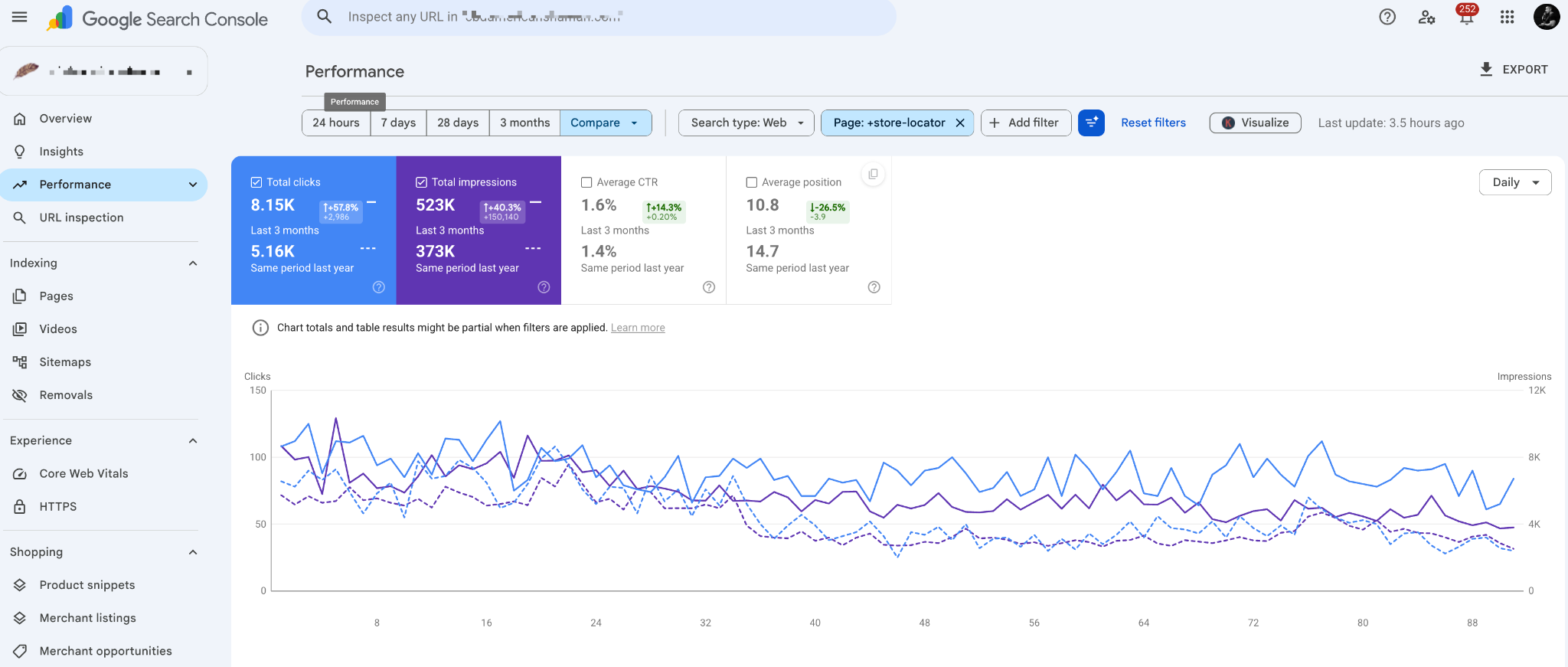
Here are the two projects’ store location pages compared side by side, where the visual semantics largely correlate despite the shift from the CBD industry to the eye health industry.

How to modify page types according to the query theme and context for local search intent
This project is from a Central European country that lists plumbers, electricians, air conditioner installers, and many other local SEO services, such as roofing, flooring, and car repair.
The main problem with the project is, as always, having too many unnecessary pages for small district and occupation combinations, along with missing visually vital components on the web documents.
Based on the initial results, the technical KPIs are still not met. For instance, the server response time should be lower than 100 ms, and the HTML crawl rate should reach 99% with only indexable, self-canonicalized, and sitemap-included URLs.
If you look at the images carefully, you can see a visual design, a mock-up design, and a content brief side by side.

Here’s how the queries are differentiated according to their type, and how a different page template is created for each. For example, experience queries like “How do I fix…” and “What should I do…” are answered from a forum subdomain with forum structured data because indexing more forum pages becomes easier.
“Near me” queries are answered directly with structured information cards that surface the service providers. For “[service name] [city name] price” queries, we blend a featured-snippet-catching responsive paragraph with the same structured information cards.
If the query is a “how to” query, it’s answered directly from the informational page.
According to search demand and the query network, one or two of these page templates are chosen and bound to each other, while a good number of unnecessary location and occupation pairs are cleaned up, along with query-parameterized filter URLs, AI-generated blog articles, and non-responsive forum pages.

One more time, you can see the “Query Deserves a Page” exercise for the project below.

See where your brand appears, where it doesn’t, and exactly how to win more visibility across search, AI, local, social, and every channel that matters.
Topical authority as a framework for local SEO
Topical authority is a multidisciplinary SEO framework that amplifies visual and textual semantics, technical SEO, branding, and PageRank. Search engine understanding is always the essence of topical authority and semantic SEO.
In this case study, we’ve covered more than 12 websites by presenting their results, topical map dynamics, visual semantics, and technical and non-technical improvements. This is the second case study in our topical authority series. Since the scope of the work is large, we didn’t dive deeply into every segment.
For instance, Google’s patent on anchor text understanding, which matters for using exact-match news domains in location-specific rankings, deserves its own treatment. Future case studies will focus on a single topic, stay on it, and reference the previous articles more effectively.
Topics on this page
If you liked the article, do not forget to share it with your friends. Follow us on Google News too, click on the star and choose us from your favorites.
If you want to read more like this article, you can visit our Technology category.