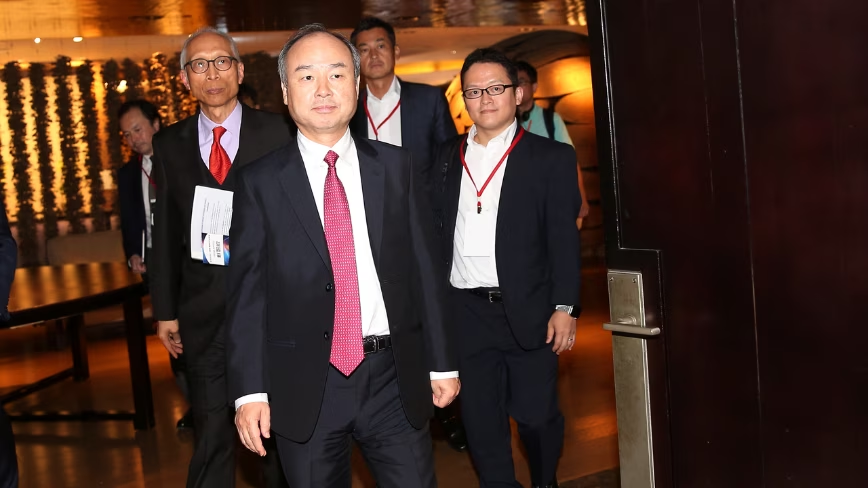
At SoftBank Group’s annual shareholders’ meeting in Tokyo on Wednesday, the founder and chief executive was asked, as he is asked at almost every public appearance now, whether the artificial intelligence boom that has driven his fortune to record highs is a bubble waiting to deflate.
He treated the question itself as the problem. To talk of a bubble, Son said, is an insult to AI.
It was not the first time he had reached for elevated language. Son has previously called bubble talk “blasphemy” and dismissed the people raising it as “not smart enough, period.”
The man who has bet more of SoftBank’s balance sheet on a single thesis than almost any investor alive does not entertain the counterargument so much as wave it away.
At the Tokyo meeting, Son told shareholders he intended to keep working into his seventies, asking for another 10 or 15 years to pursue what he calls artificial superintelligence, the stage he believes arrives after artificial general intelligence and solves problems humanity never imagined it could.
He has put a number on the scale of the opportunity too. The AI revolution, he told CNBC in Paris earlier in June, is “more than 10x, probably 50x bigger” than the dot-com boom, and the beginning of a technological shift that could run for 50 to 100 years.
The boom comparison is the one Son would rather not invite, given his own history with it.
The last time SoftBank sat at the top of the Japanese market was February 2000, when the dot-com bubble was about to burst. Within a year, its shares had fallen roughly 90%.
This month, SoftBank briefly overtook Toyota as Japan’s most valuable listed company for the first time since that peak, before the carmaker reclaimed the spot three days later.
What sits behind the confidence is a position of unusual concentration. SoftBank’s cumulative bet on OpenAI has reached roughly $64.6bn, giving it an ownership interest of around 13%.
To fund the follow-on, the group secured a $40bn bridge loan and has borrowed against the stake at spreads that reflect the risk lenders attach to it.
S&P has lowered its outlook on SoftBank’s credit, citing the possibility that the OpenAI exposure could weigh on the group’s liquidity.
None of which appears to trouble Son, who has described the company’s posture as “total offence mode” and is recasting it as an AI-era industrial holding company.
The agenda on Wednesday reflected the shift. Shareholders were asked to amend the articles of incorporation to add AI, semiconductors, robotics, and data centres to the stated business purposes, a tidying of paperwork to match where the money has already gone.
Son’s next frontier, he told the room, lies beyond the chips and the models. He named humanoid and industrial robotics, what he calls physical AI, as the next trillion-dollar industry, and predicted that superintelligence would eventually add at least 10% to global GDP.
“Almost all human activities,” he said, “eventually will be some kind of collaboration with superintelligence and physical AI.”
The financial logic of that vision will be tested soon enough. A run of mega technology listings is due in the coming months, with OpenAI and Anthropic among the companies that have filed, and SoftBank’s standing rests heavily on whether those debuts validate the prices the market has already paid.
For now, the man steering the largest single AI wager in corporate Japan has settled on his answer to the bubble question, which is to refuse to dignify it.
Whether that is conviction or salesmanship is, in Son’s case, a distinction without much of a difference.
He has spent a quarter of a century insisting the future was arriving faster than anyone believed, and has been spectacularly right and spectacularly wrong in roughly equal measure.
The shareholders who gave him another decade on Wednesday were betting, as they always have, on which it is this time.
If you liked the article, do not forget to share it with your friends. Follow us on Google News too, click on the star and choose us from your favorites.
If you want to read more like this article, you can visit our Technology category.