“#Stealing information from host plants: How the parasitic dodder plant flowers”
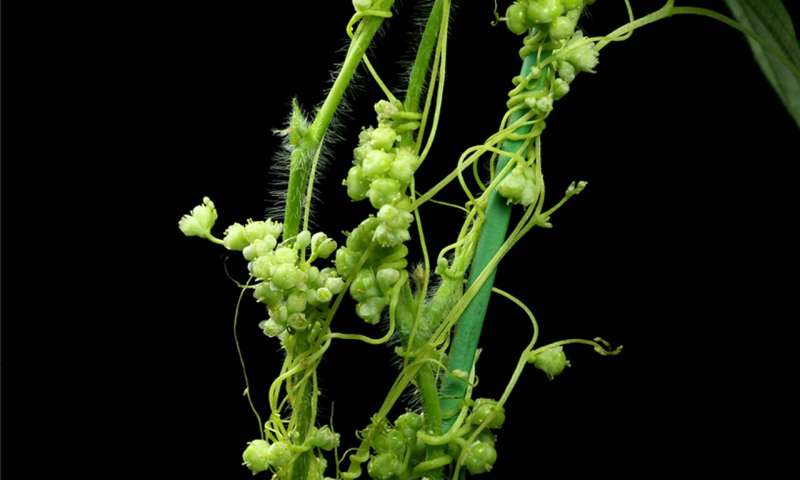
Using biochemical tools, the team further demonstrated that when the host expresses FT signals, the flowering-inducer FT can travel into C. australis and activate the flowering program of C. australis.
“The dodder does not flower autonomously; instead, when the host plant produces the FT signal protein to activate flowering, the host-produced FT protein is transported into the dodder, thereby activating dodder flowering,” said WU.
This study reveals that by eavesdropping on host FT flowering signals, the dodder can synchronize its flowering with its hosts.
This behavior is important, as it may enable dodders to parasitize diverse host plants: If the dodder has a fixed flowering time, and it is much later than the host, then when the host flowers, the nutrient level of the host plant usually drops because of seed development, and the host may even die before the dodder flowers.
On the other hand, if the dodder flowers much earlier than the host, dodder growth will end prematurely, and in this scenario, the dodder does not make as many seeds as the dodder that flowers at a time similar to the host.
This study sheds important light on the physiology, ecology, and evolution of dodders and may provide new strategies for biocontrol of parasitic weeds in agriculture and forestry.
More information:
Guojing Shen el al., “Cuscuta australis (dodder) parasite eavesdrops on the host plants’ FT signals,” PNAS (2020). www.pnas.org/cgi/doi/10.1073/pnas.2009445117
Stealing information from host plants: How the parasitic dodder plant flowers (2020, August 31)
retrieved 31 August 2020
from https://phys.org/news/2020-08-host-parasitic-dodder.html
This document is subject to copyright. Apart from any fair dealing for the purpose of private study or research, no
part may be reproduced without the written permission. The content is provided for information purposes only.
If you want to read more Like this articles, you can visit our Science category.
if you want to watch Movies or Tv Shows go to Dizi.BuradaBiliyorum.Com for forums sites go to Forum.BuradaBiliyorum.Com